30 Oct 2026 · Chirag Asnani
Pharma: Relief, Then Rotation
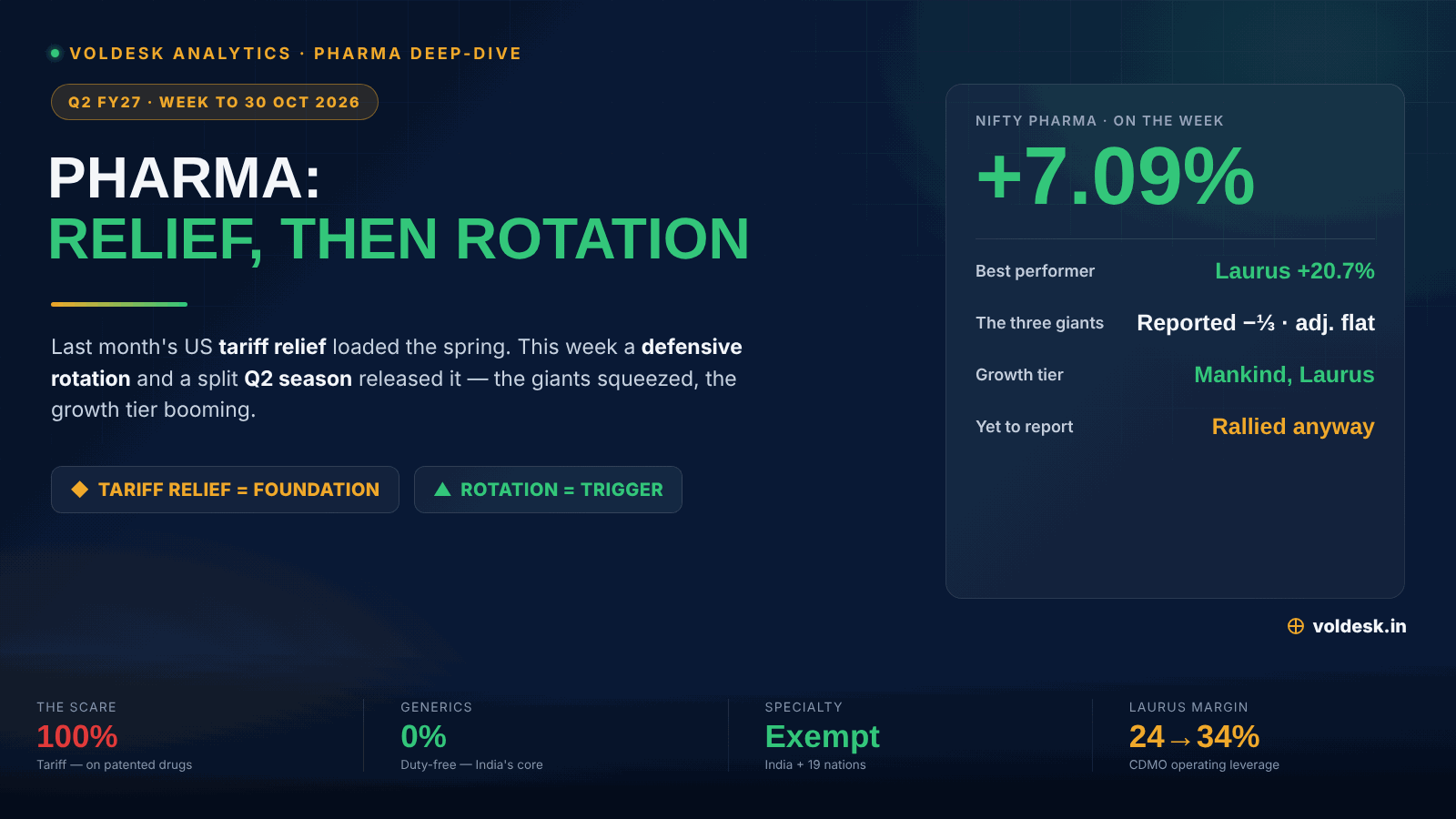
Nifty Pharma had its best week in a long while, climbing more than 7% in the five sessions to 30 October. We only had room for a few lines on it in this week's wrap, so here is the fuller version. The puzzle is plain enough: the three largest drugmakers all posted headline Q2 profits down by roughly a third, and the sector rose 7% anyway. That only makes sense once you stop hunting for a single trigger and read it as a sequence instead. The groundwork went in last month, when US tariff relief quietly took the sector's biggest risk off the table. This week two things set it off: money rotating into defensives while the rest of the market stayed stuck on oil, and a Q2 season that showed where the growth has gone. The relief was the loaded spring. This week's rotation and results let it go.
The foundation: a tariff scare, right-sized
Start with the backdrop, and note when it happened: last month, not this week. Back in April the US announced 100% Section 232 tariffs on patented pharmaceutical products on national-security grounds, to be phased in over the autumn. It read as an existential threat to Indian pharma. In practice it was far smaller, for a structural reason. The duty applies only to patented, branded drugs, and the Commerce notice keeps generics and their active ingredients out of scope entirely. Generics are the bulk of what India ships to the US, so the core of the India model was never in the firing line.
The late-September move was narrower than the coverage implied, and the detail matters. Washington did not give India a blanket exemption. It granted zero-tariff treatment to a specific set of categories: drugs for rare diseases (where every approved use carries orphan designation), nuclear medicines, plasma-derived therapies, fertility drugs, cell and gene therapies, antibody-drug conjugates, and CBRN medical countermeasures. The relief applies to India and nineteen other jurisdictions, and only where there is an existing or forthcoming trade-and-security framework, or an urgent US health need. So it is a targeted carve-out for high-value complex drugs, not a free pass for the whole export book. Sitting on top of the generics exclusion, though, it clears away most of the tail risk that was left.
Add the two together and the feared tax barely grazes the India model: generics out of scope, the complex-drug carve-out in place, a thin slice of patented branded exports still exposed. But all of this was settled weeks ago. It did not move prices this week. What it did was leave the sector de-risked, a policy tailwind sitting there waiting for a reason to show up in the tape.
The coil: rotation into a de-risked sector
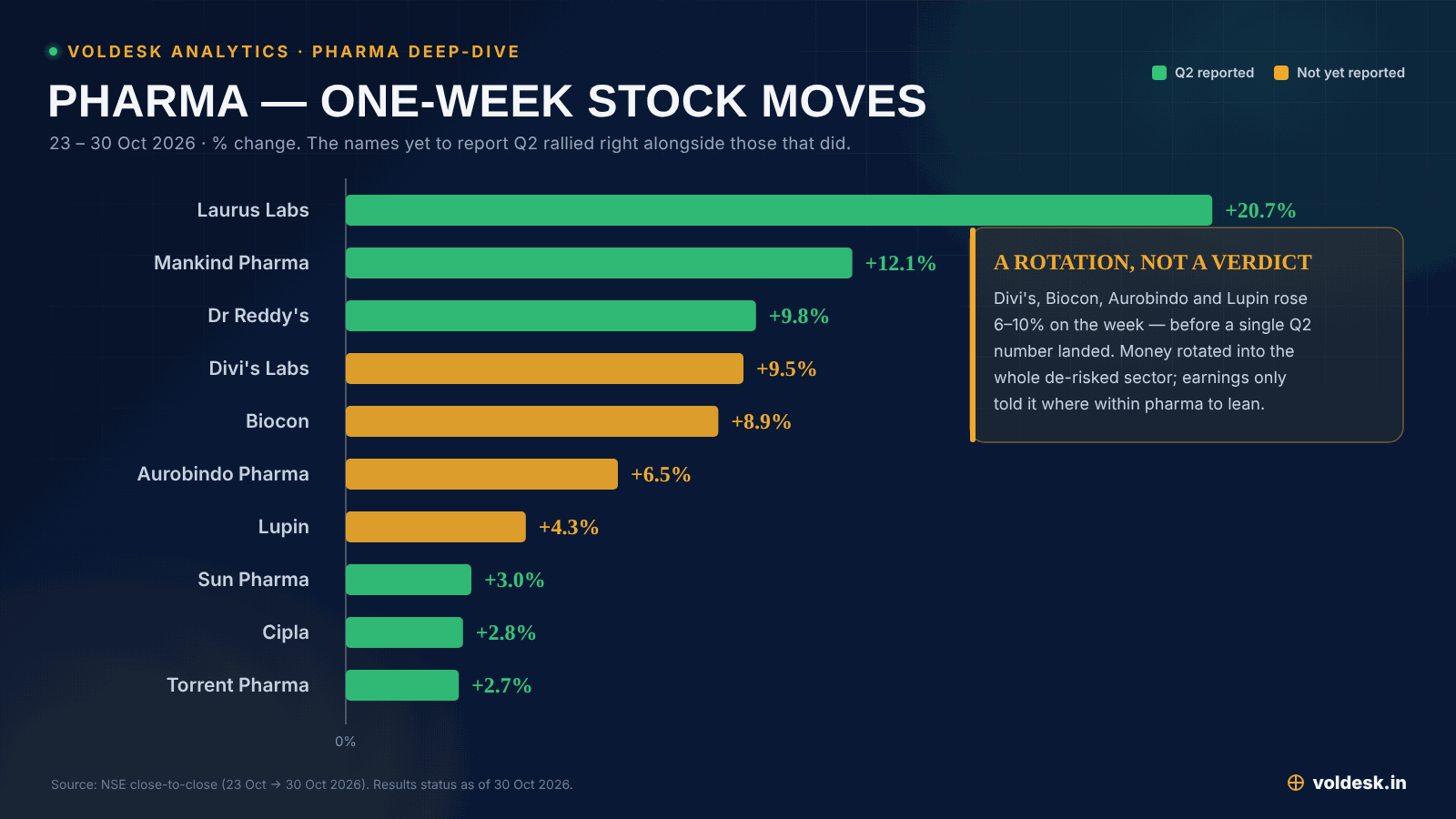
The reason showed up this week, in two parts. First, rotation. With the broader market boxed in a range and weighed down by oil (the picture we set out in this week's wrap), money went looking for shelter, and pharma was the obvious place to find it now that the tariff cloud had lifted. It topped the sector table at +7.09%, healthcare close behind at +6.91%, the two of them more than double the next sector (Media, +4.34%). Twelve of the thirteen NSE sectoral indices closed green; the Nifty 50 managed just 2.00%. This was a defensive-led week, and pharma was the loudest expression of it. Second, the results. The Q2 numbers, once you get past the headline, point to where the growth actually sits. And the giveaway that this was a rotation into the sector as a whole, not a stock-by-stock verdict on earnings, is the behaviour of the names that have not reported yet: Divi's up 9.5% on the week, Biocon 8.9%, Aurobindo 6.5%, Lupin 4.3%, none of them with a single Q2 figure out. The money bought pharma as a theme. The earnings only decided where inside it to lean.
The giants: one headline, three different stories
On a reported basis, yes, all three of the big names fell about a third at the bottom line, which is what made the 7% rally look so odd. But the word reported is carrying a lot here. Look at the three separately and none of them fits the simple US-price-erosion story the headline suggests. With Sun, there was barely a decline at all.
Take Sun Pharma first, because it is the clearest case of a misleading headline. Revenue grew 11.9% and India formulations rose 17.3%. Reported profit still fell 36%, to ₹1,989 crore, and almost all of that drop is two one-time items: a ₹923 crore US antitrust settlement and ₹346 crore of Organon acquisition costs, ₹1,269 crore in all. Back those out and adjusted profit was ₹3,162 crore, up 1.4%. Underlying profitability was broadly stable, strong India growth offsetting an 8% slip in US formulation sales to $455 million.
Dr Reddy's dropped for a different reason, and it is not erosion either. Its North America revenue fell sharply, almost entirely because last year's quarter was loaded with high-margin generic Revlimid (lenalidomide) that has since gone off exclusivity. Strip lenalidomide out and the underlying base business grew at double-digit rates. A cliff everyone saw coming, not a fresh leak. The margin bears that out, holding at a 20.6% EBITDA margin, with India and emerging markets both contributing growth.
Cipla comes closest to a true operating squeeze, profit down about 35% on weaker North America sales. Elevated R&D investment was another factor weighing on reported profitability, alongside that North American weakness: R&D spend rose to ₹423 crore in the quarter, about 5.7% of revenue, with the EBITDA margin landing at 18.7%. Softer US performance and heavier investment both played a part, not pricing on its own.
| The giants (Q2 FY27) | Revenue YoY | Net profit YoY | Stock, 1-wk |
|---|---|---|---|
| Sun Pharma* | +11.9% | −36% | +3.0% |
| Dr Reddy's | −1.5% | −36% | +9.8% |
| Cipla | −2.4% | −35% | +2.8% |
*Sun Pharma: reported profit hit by ₹1,269 crore of one-time charges (a US antitrust settlement plus Organon deal costs); adjusted profit ₹3,162 crore, up 1.4% YoY.
So the neat version, that the giants are being ground down by US price erosion, does not hold up. The pricing pressure is real and structural, and Sun's −8% US number is the standing reminder of it. But what actually shaped this quarter was a litigation charge at Sun, a Revlimid base at Dr Reddy's, and an R&D decision at Cipla. The market looked through all three, which is why the stocks rose while the reported profits fell.
Where the growth actually is
Step away from the giants and the sector looks fine. The growth has just moved, into two pockets: India-branded formulations, and specialty and contract manufacturing (CDMO). Mankind Pharma, almost wholly a domestic-branded business, grew revenue 17% and profit 38%, with margins widening. Torrent Pharma looks explosive at first glance, revenue up 51%, but most of that is the JB Chemicals acquisition coming into the numbers; strip it back and margins held at a sector-leading 33%, while reported profit slipped 10% on the interest and amortisation the deal brings. The real standout is Laurus Labs. The CDMO and API maker grew revenue 34% and profit 126%, with the operating margin jumping from 24% to 34% as its contract-manufacturing book scaled up, and the stock rose nearly 21% on the week, the largest move of the ten names we track. Mankind's 38% profit growth took its stock up 12% over the same stretch. Those two are the part of this rally with genuine earnings underneath, which the giants, up on sentiment while profits fell, were not.
| The growth tier (Q2 FY27) | Revenue YoY | Net profit YoY | Stock, 1-wk |
|---|---|---|---|
| Mankind Pharma | +17.3% | +37.7% | +12.1% |
| Torrent Pharma* | +50.8% | −9.6% | +2.7% |
| Laurus Labs | +33.5% | +124.7% | +20.7% |
*Torrent: revenue and operating profit lifted by the JB Chemicals acquisition; net profit held back by deal-related interest and amortisation. (Lupin, Aurobindo, Divi's and Biocon had not reported at the time of writing; their shares are included above only for the weekly move.)
The bottom line
The way to read the week is as a sequence. Last month's tariff relief did the groundwork, lifting a real tail risk and leaving the sector primed. This week a defensive rotation set it off, and the Q2 season gave it a direction, pointing money towards the India-branded and specialty/CDMO names rather than the giants. The giants' headline profits fell on one-offs and base effects, their shares rose anyway, and their genuine problem, US generic pricing, stays a slow grind rather than this quarter's event. A rotation like this can carry a whole sector for a few weeks on relief and a flight to safety. Whether it lasts comes down to two things: the giants steadying their US business, and the growth tier keeping up the pace. For now the second of those looks the more dependable.
Keep reading
30 Oct 2026
Market Wrap: Pharma to the Rescue
For the third week running, the market moved a lot and went almost nowhere. After The Snapback and The Snapback Fades , this week was the bo…
23 Oct 2026
Market Wrap: The Snapback Fades
Last week we titled this column The Snapback , and warned in the same breath that it was "relief, not a verdict" — that we would not declare…
16 Oct 2026
Market Wrap: The Snapback
Two weeks ago we titled this column Nowhere to Hide — an eighth straight losing week, the Nifty at its lows, the whole market bracing for th…
Disclosure — No security recommendation. Macro commentary. This article is for information and education only and does not constitute personalised advice. Investments in securities are subject to market risk; no returns are assured.