30 Aug 2026 · Chirag Asnani
Indian IT: From Growth to Cash Cow
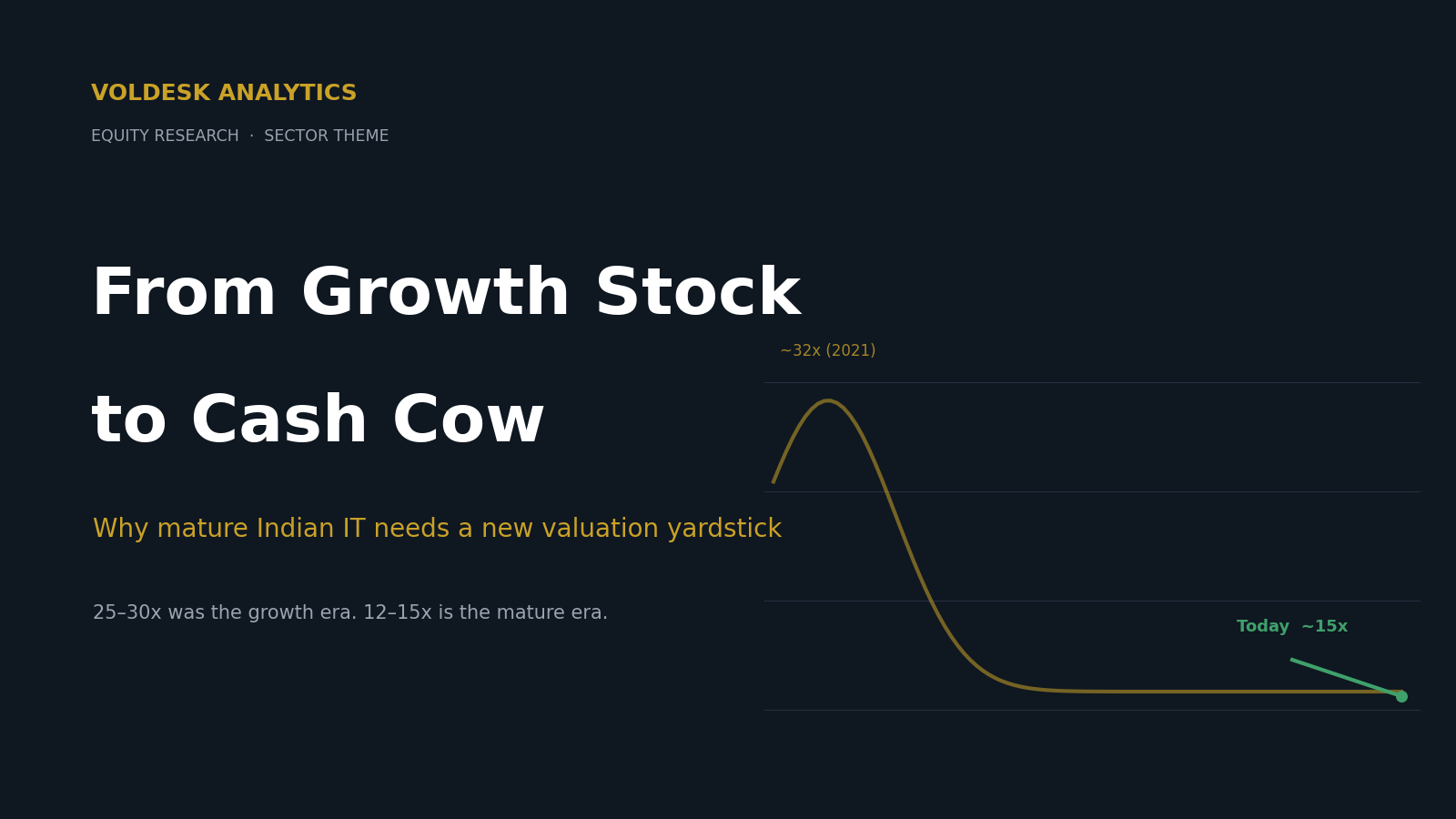
For fifteen years, Indian IT services was the market's dependable growth machine, and investors paid for it accordingly. Through most of the last decade the large caps changed hands at 25–30x earnings, and at the 2021 peak the sector briefly touched the low-30s. That multiple was a bet on a simple idea: revenue would compound in the low-to-mid teens more or less forever — and for a long time, it did.
That era is over — at least for the mature leaders. TCS, Infosys and HCLTech now grow at low single digits, and the market has quietly repriced them to roughly 15x. The common instinct is to call this "cheap": if a business that used to trade at 28x is now at 15x, surely it is a bargain. That instinct is a mistake. It applies yesterday's yardstick to today's company. The more useful question is not "why is IT so far below its history?" but "what multiple does a mature, cash-rich, low-growth business actually deserve?" — and the answer is not 28x.
The growth premium, and why it has gone
The de-rating is not an Indian anomaly or simply a sentiment blip; it reflects a fundamental change in the industry's growth profile. It has happened in slow motion over four years.
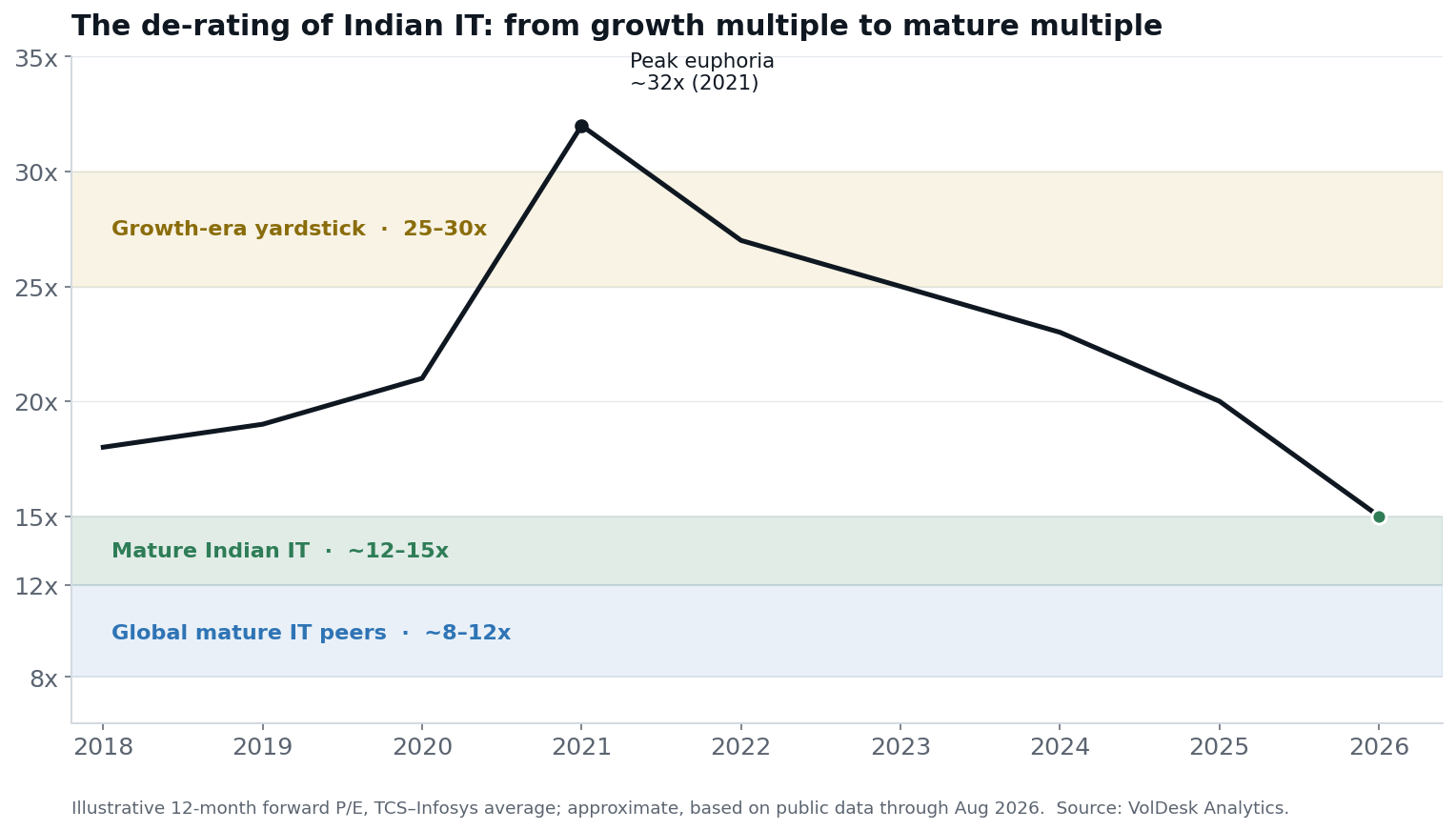
The fundamentals behind the chart are unambiguous. At the June-quarter results, Infosys trimmed its full-year revenue guidance to 1.5–3.0% in constant currency; HCLTech guided to 1–4%; TCS, which no longer gives formal guidance, saw broadly flat organic growth beneath a currency-flattered headline. These are not the numbers of a sector in a temporary soft patch. They are the numbers of an industry that has matured — where the labour-arbitrage model is fully scaled, discretionary budgets are tight, and the next technology wave (generative AI) is as much a threat to effort-based billing as it is an opportunity.
A business growing at 2–4% is not a slower version of a business growing at 14%. It is a different asset, and it needs a different multiple.
The right comparison is not past IT — it is other cash cows
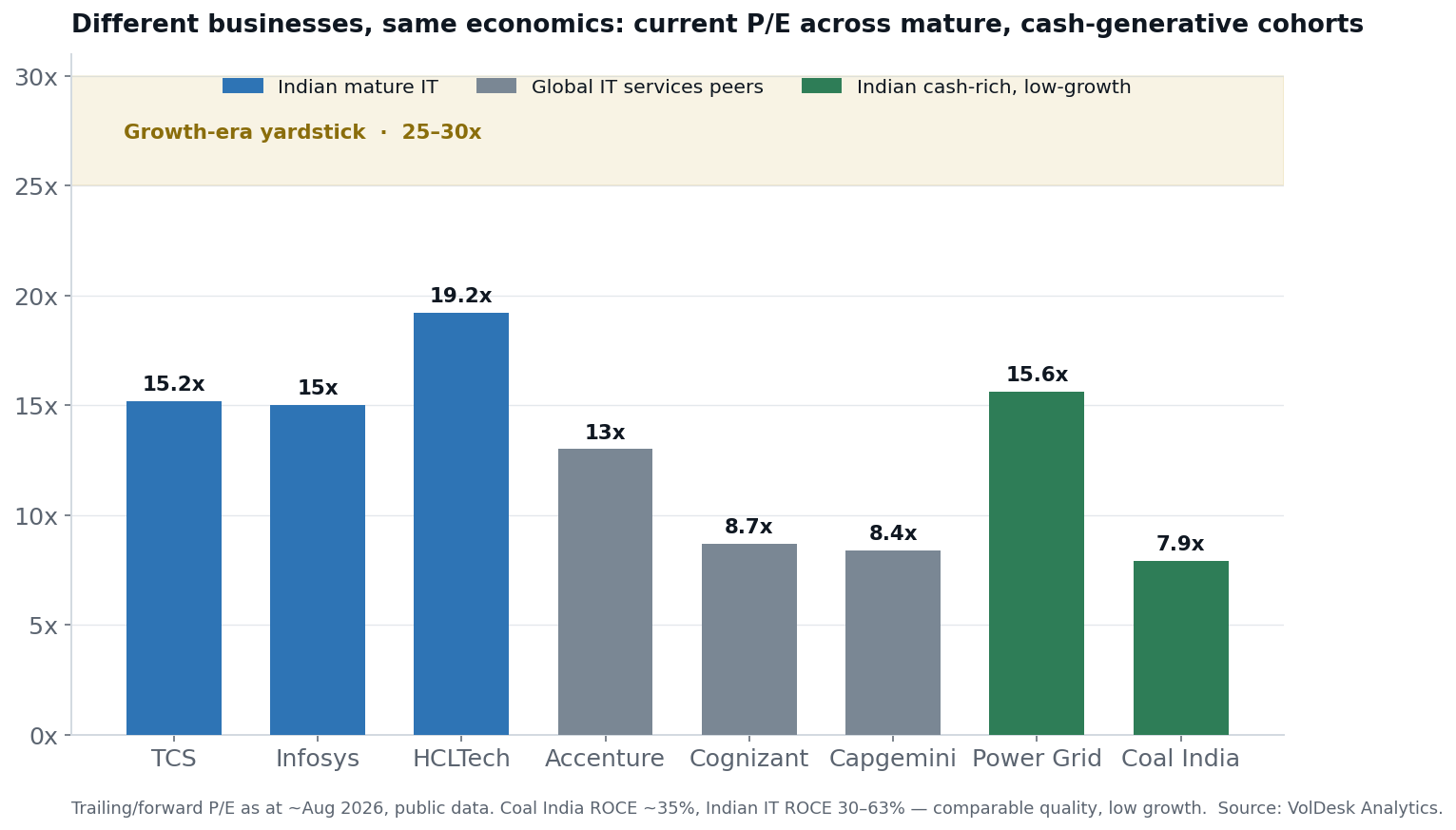
If Indian IT is no longer a growth sector, the honest way to value it is to stop comparing it to its own history and start comparing it to different businesses that share its economics today: mature, highly cash-generative, high return on capital, and growing slowly. When you line those businesses up, a clear pattern appears — none of them is priced on growth, and none carries anything close to a 25–30x multiple.
| Company | Cohort | P/E | Recent growth | Return profile | Cash return |
|---|---|---|---|---|---|
| TCS | Indian IT | 15.2x | ~flat organic | ROCE ~63% | 2.9% yield + buybacks |
| Infosys | Indian IT | 15.0x | 1.5–3% CC | ROCE ~40% | 4.2% yield |
| HCLTech | Indian IT | 19.2x | 1–4% CC | ROCE ~30% | 4.2% yield |
| Accenture | Global IT | ~13x fwd | low single digit | high, asset-light | ~2% + buybacks |
| Cognizant | Global IT | ~8.7x | low single digit | solid | ~2% + buybacks |
| Capgemini | Global IT | ~8.4x | ~flat | solid | dividend + buyback |
| Power Grid | Utility | 15.6x | ~1% | ROE ~15% | 3.4% yield |
| Coal India | Resources | 7.9x | ~7% (PAT flat) | ROCE ~35% | 6.6% yield |
Two comparisons do the heavy lifting. First, global IT services: Accenture — the highest-quality name in the peer set — has itself de-rated from ~34x in 2021 to about 13x forward, while Cognizant and Capgemini sit near 8–9x. The same maturity that pulled Indian IT down has pulled the global cohort down further. Second, domestic cash cows: Coal India earns a ~35% return on capital — comparable to Indian IT's — throws off a 6.6% dividend yield, and grows slowly. The market prices it at ~8x. Power Grid, a low-growth, cash-generative utility, trades at ~15.6x. None of these businesses is awarded a growth multiple, because none of them is growing.
Different businesses, same economics
The obvious objection is that a regulated power utility and a state-owned coal miner have nothing to do with a global IT services exporter — and that is correct. We are not claiming the businesses are alike; we are pointing to a shared economic profile: mature, slow-growing, cash-generative and high-return. Markets do not price a label — "IT", "power", "mining" — they price that profile, and they consistently decline to attach a growth multiple to it. If anything, the comparison flatters IT. A regulated utility earns a capped, formula-set return; a commodity producer carries price cyclicality and an ESG discount. Mature Indian IT has none of those constraints — it is asset-light, net-cash, globally diversified and unregulated, with returns on capital as high or higher than either. Those advantages are exactly why it deserves a premium to the domestic cash cows — a mid-teens multiple rather than a high-single-digit one — but they do not restore the growth that a 25–30x multiple would require. Better economics justify a better mature multiple; they do not turn a mature business back into a growth one.
A yardstick that fits: 12–15x, not 25–30x
Put the two anchors together and a coherent framework emerges. The fair multiple for a mature, cash-generative business is not a memory of its growth-era rating; it is a function of three things it still has — low but positive growth, a high and durable return on capital, and a large, reliable cash return. On that basis:
- Indian mature IT: roughly 12–15x. It deserves a clear premium to the global peers — higher returns on capital, net-cash balance sheets, a structural offshore-cost and currency tailwind, and still-positive (if modest) growth. But it does not deserve a premium to its own past, because the growth that justified the past is gone.
- Global IT peers: roughly 8–12x. Lower growth, lower returns, and a market that has already made the adjustment.
Seen this way, the market's ~15x on TCS and Infosys is not a distressed bargain waiting to snap back to 28x — it is a rational re-anchoring to the top of a mature range, helped by their quality and yield. HCLTech, at ~19x, is if anything at the fuller end of what the framework supports. The uncomfortable implication for anyone still anchored to the old number is that the "40% discount to history" is not an opportunity; it is the correction.
The multiple follows growth, not the sector
The mature businesses in our comparison are not being priced on high growth. That does not mean growth has stopped commanding a premium — as the valuations of Persistent and Coforge demonstrate. The clearest proof that the market is repricing maturity — not "IT" — sits inside the same sector. The mid-cap names that are still compounding fast continue to command rich multiples: Persistent Systems trades near 46x on roughly 20% growth, and Coforge near 45x on 25–30% growth (helped by acquisitions). Same industry, same clients, the same GenAI backdrop as TCS and Infosys — and roughly three times the multiple. The market is not punishing Indian IT as a category; it is paying up for growth wherever it still exists and withdrawing the growth premium where it has faded. That is the whole argument in a single line: the fair multiple tracks the growth rate, not the sector name.
What changes when you switch yardsticks
Changing the yardstick changes both the verdict and the way you monitor these names. Under the old growth lens, you watch for a revenue re-acceleration that re-rates the stock back toward 25x — a catalyst that, on current evidence, is not coming. Under a mature lens, you value them the way you already value a utility or a consumer cash cow: on free-cash-flow yield, dividend and buyback, and the durability of return on capital. The return now comes primarily from dividends, buybacks and modest earnings growth — rather than investors paying an ever-higher multiple. A 6% free-cash yield and a 4% dividend on a 40%-plus-ROCE franchise is a perfectly respectable outcome; it is simply a different outcome from the one the sector delivered in its growth decade.
This is not a bearish argument. A high-quality, net-cash, cash-returning franchise at a fair mature multiple is a fine thing to own; it is just not a growth stock, and pretending otherwise leads to two errors — overpaying on the way down because "it used to be more expensive," and waiting for a re-rating that the fundamentals no longer justify. The discipline the moment demands is unglamorous: mark the yardstick to the business, not the business to the yardstick.
The takeaway
Indian IT's mature leaders have completed a quiet but profound transition — from compounding growth stories to cash-returning utilities of the digital economy. The multiple has followed the fundamentals down toward what we believe is a reasonable mature range: low-to-mid teens for the Indian names, high-single digits abroad. Valued on that yardstick, the sector is broadly fairly priced, and the case for owning it rests on cash and quality rather than growth. The 25–30x era is not paused. It is finished — and the sooner an investor's model accepts that, the cleaner the decisions that follow.
References & further reading
- Company disclosures — TCS, Infosys and HCLTech Q1 FY27 results and guidance (June-quarter 2026).
- GuruFocus — Accenture forward P/E and historical range: gurufocus.com/term/forward-pe-ratio/ACN
- Screener.in — Coal India valuation and returns: screener.in/company/COALINDIA/consolidated/
- Screener.in — Power Grid valuation and returns: screener.in/company/POWERGRID/consolidated/
- VolDesk Analytics — Indian IT sector research notes (TCS, Infosys, HCLTech, Coforge, Persistent; mature-vs-growth valuation framework — available on request).
Keep reading
02 Oct 2026
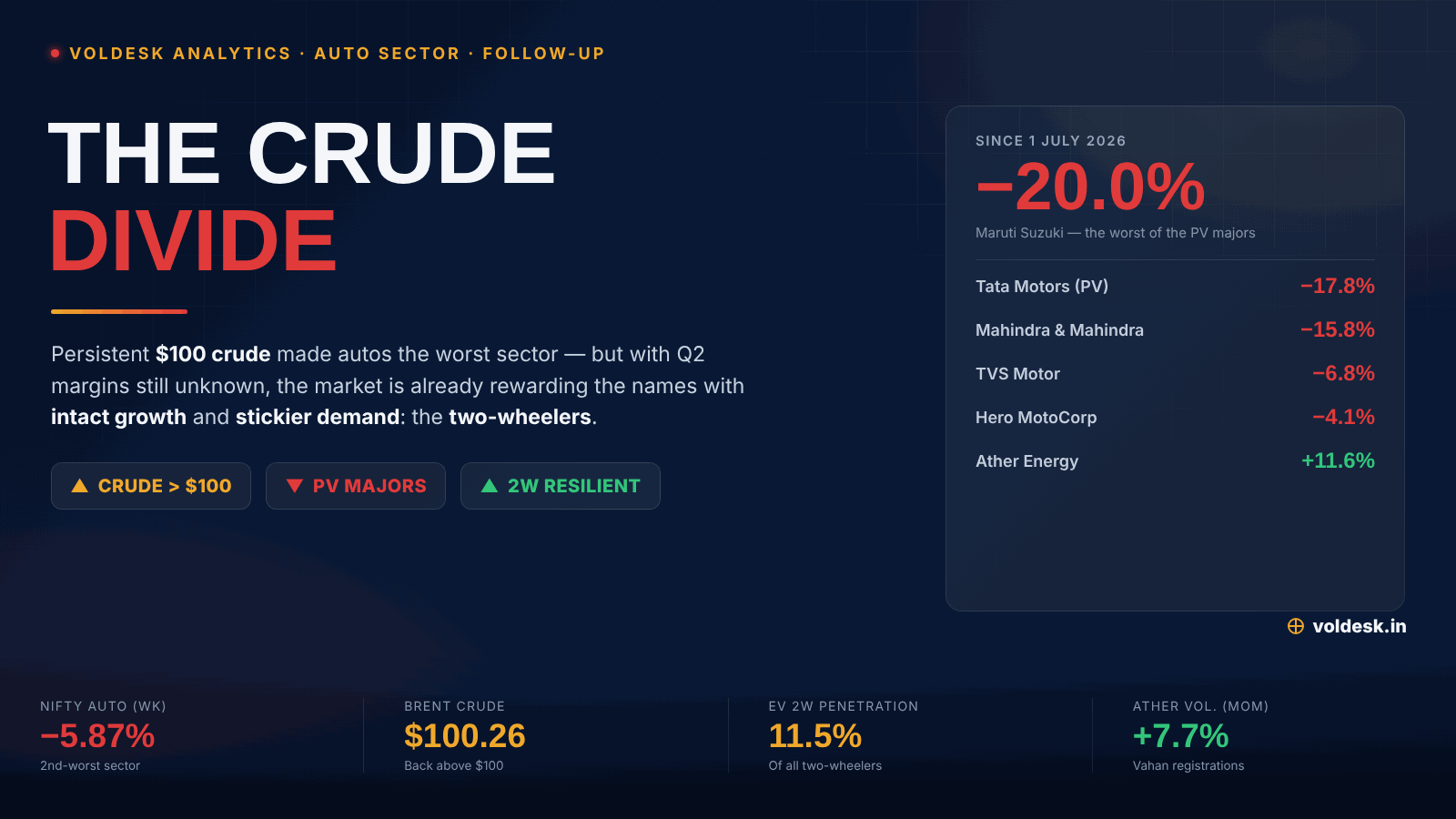
Autos: The Crude Divide
Six weeks ago, in Record Sales, Shrinking Margins , we flagged a paradox in India's auto sector: record Q1 volumes on the surface, a commodi…

01 Oct 2026
Market Wrap: Nowhere to Hide
Last week we framed it as Money Turns Defensive — money rotating out of rate-sensitive sectors into the shelter of FMCG, pharma and healthca…
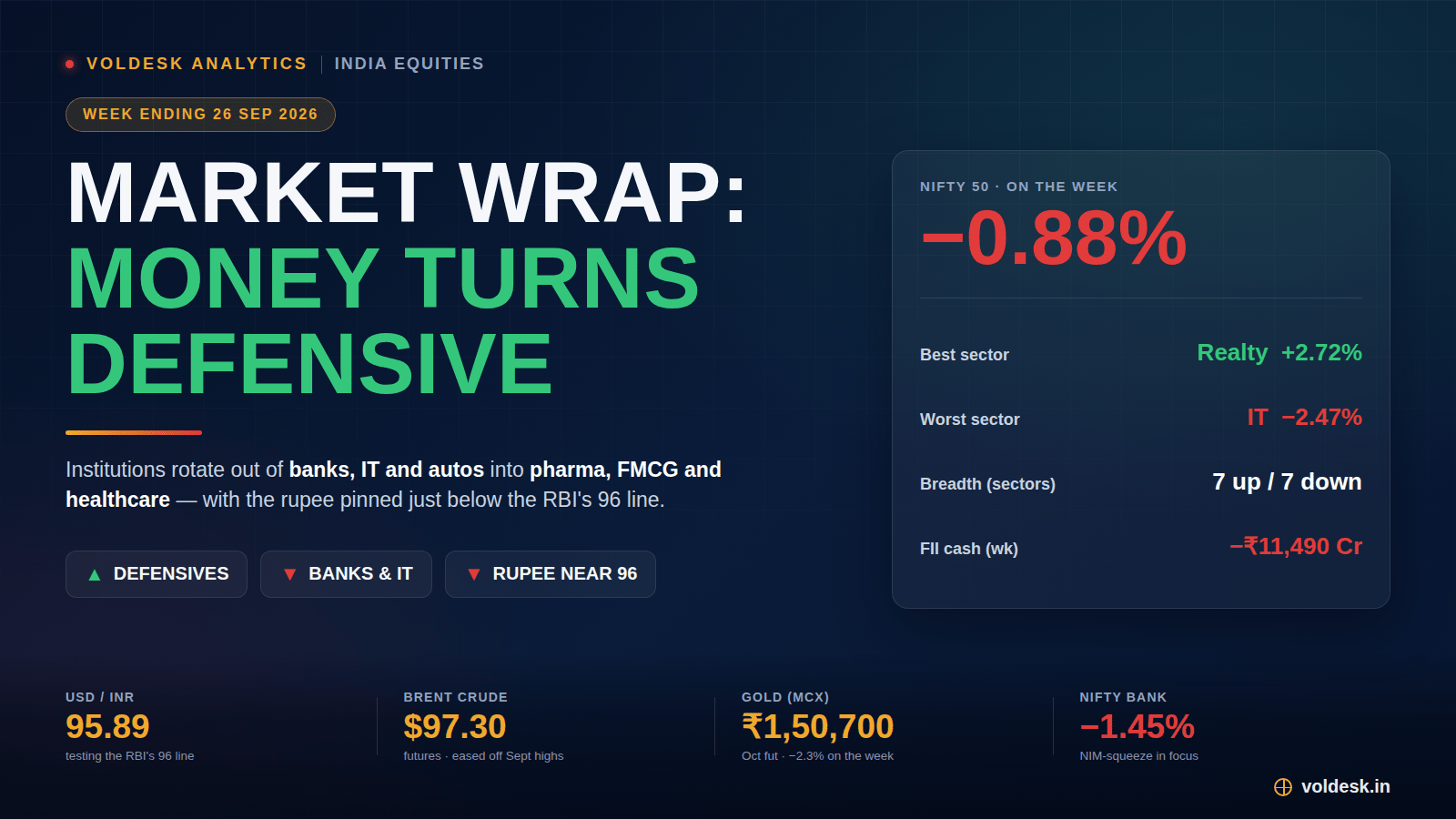
26 Sep 2026
Market Wrap: Money Turns Defensive
One week after the Fed's hike, the rotation we mapped is showing up on the tape. In our post-Fed piece , we argued the move would split the …
Disclosure — Educational market commentary only. Not a recommendation to deal in any security. Multiples and figures are drawn from public sources as at the date of publication (~August 2026), are approximate, and may change. This article is for information and education only and does not constitute personalised advice. Investments in securities are subject to market risk; no returns are assured.