01 Oct 2026 · Chirag Asnani
Market Wrap: Nowhere to Hide

Last week we framed it as Money Turns Defensive — money rotating out of rate-sensitive sectors into the shelter of FMCG, pharma and healthcare. This week the market tore that playbook up. The Nifty 50 fell 3.11% to 22,421.95, its eighth straight losing week, and this time there was nowhere to hide: twelve of thirteen sectoral indices closed red, and the defensives that sheltered money last week were among the hardest hit. The trigger was a shift in what the market expects from the RBI — from a comfortable hold to a live risk of a rate hike at the October 5–7 policy.
Sectors — the tape
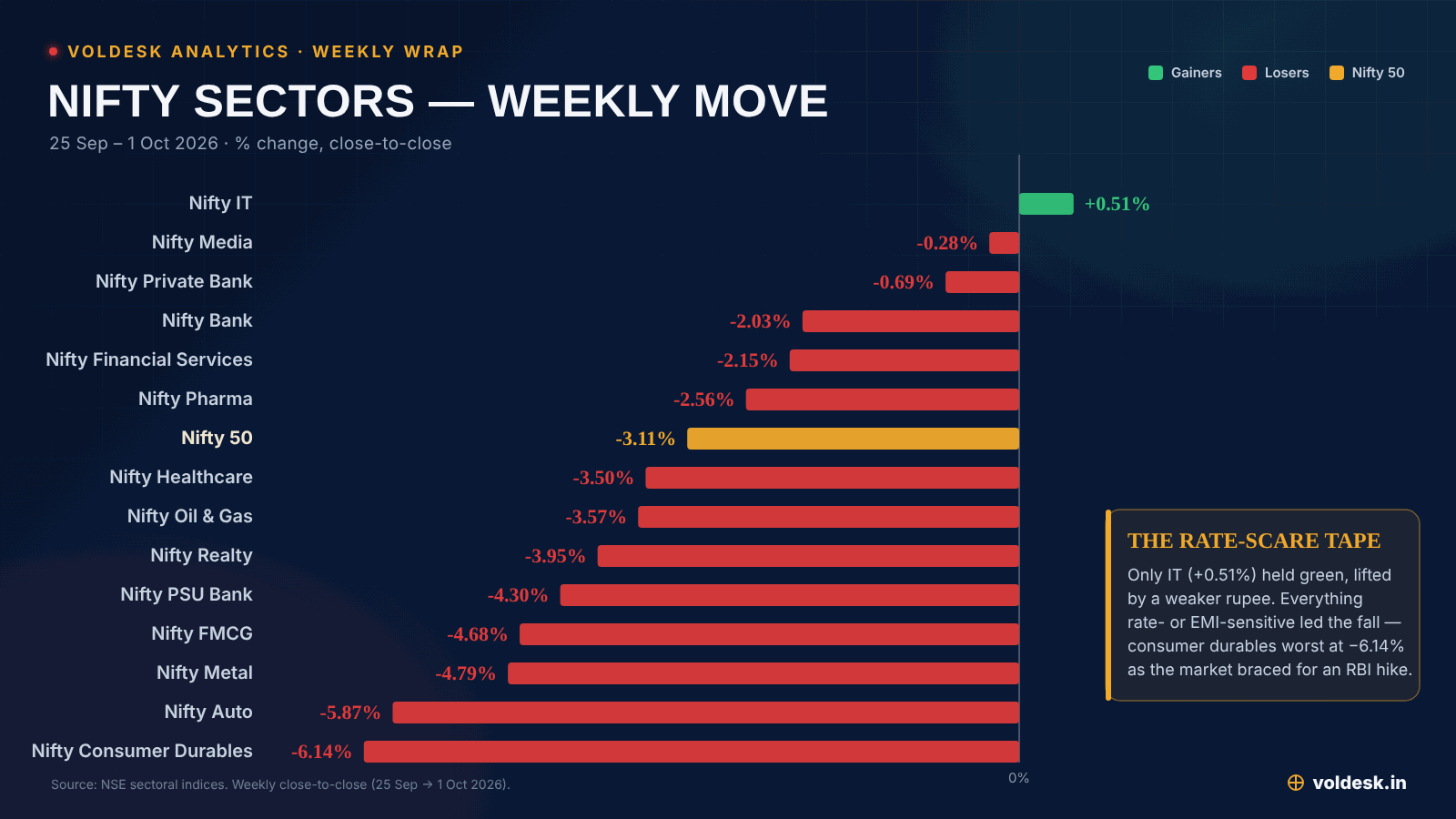
The decline was broad and it was deep. Nifty Consumer Durables was the worst sector of the week, down 6.14%, with Nifty Auto (−5.87%), Nifty Metal (−4.79%) and Nifty FMCG (−4.68%) close behind. Consumer durables took the brunt because it sits exactly where a rate scare does the most damage: big-ticket, discretionary purchases, many of them financed on EMIs. With inflation sticky and the cost of living already stretched, the prospect of higher rates is the last thing a household weighing a new fridge or air-conditioner wants to hear — and the index fell accordingly.
The cruellest part of the week was the reversal in the defensives. ITC fell 4.87%, wiping out the 2.55% it had gained the week before; Hindustan Unilever dropped 5.50% after a small gain. Tata Steel gave back 5.30% having risen 1.31% the previous week. Last week's shelter became this week's source of losses, and FMCG went from one of the few green sectors to the second-weakest corner of the market.
Only one sector finished higher: Nifty IT, up 0.51%, helped by a rupee that kept sliding — a weak rupee lifts IT's dollar revenue in rupee terms. The other relative shelter was, ironically, the banks: Nifty Private Bank fell just 0.69% and Nifty Bank 2.03%, the mildest declines after IT and media. These were last week's worst performers; this week they were the ones left standing — an oversold bounce rather than a change of heart.
Our forecast: where we were right, where we were wrong
We put out a forecast every week, so we hold ourselves to it. Here is last week's scorecard, plainly — and we got just one of five wrong.
| Our forecast (Sep 26) | Verdict | What actually happened |
|---|---|---|
| Defensives — FMCG, pharma, healthcare — are better placed | Wrong | They led the falls: FMCG −4.68%, Healthcare −3.50%, Pharma −2.56%. |
| Banks and IT are the rate- and inflation-sensitive losers | Right | Nifty Bank fell over 2%; IT's +0.51% is noise after weeks of falling, with no change to its growth outlook. |
| Autos stay under pressure | Right | Nifty Auto −5.87%, the second-worst sector of the week. |
| FIIs keep exiting with US yields high and the rupee soft | Right | FII cash −₹34,966 cr, triple the prior week; rupee broke 96. |
| The RBI (Oct 5–7) is the main event; watch 96 on USD/INR | Right | Rupee broke 96 to 96.49; the policy is now the market's pivot. |
We got the defensives forecast wrong, flat out. We expected the rotation into safety to continue; instead it reversed inside a week, and reversed hardest in the names we had pointed to. The lesson is that when the whole market is repricing a single macro variable — here, the path of rates — sector rotation stops working, because everything falls together. What we did read correctly was the external pressure: foreign outflows, the rupee and the centrality of the RBI meeting. Those judgements are what still matter for the week ahead.
Macro backdrop: oil, rupee, gold, yields
Every cross-asset signal pointed the same way this week — against risk. Brent crude reclaimed the $100 mark, trading around $100.26, undoing the relief of the prior fortnight and feeding straight back into India's import and inflation math. The rupee broke 96, sliding to 96.49 — a level the RBI had defended for weeks — as the dollar stayed firm on the back of US 10-year yields near 5.25%, still around a two-decade high. Gold, the one hedge that held, was roughly flat at about ₹1,49,000 per 10g on the MCX November future. Higher oil, a weaker rupee and high global yields are precisely the mix that argues for tighter, not looser, policy — which is why the market spent the week bracing for a hike.
| Asset | Level | On the week |
|---|---|---|
| Brent crude | $100.26 | Back above $100, up from ~$97 |
| USD/INR | 96.49 | Broke 96; fresh multi-month low |
| Gold (MCX Nov fut) | ₹1,49,000/10g | ~Flat after a strong run |
| US 10-Yr Treasury | ~5.25% | Near a two-decade high |
Foreign flows
The flow data tells you why breadth was so poor. Foreign investors pulled ₹34,966 crore out of the cash market on the week — roughly triple the ₹11,490 crore they withdrew the week before, and part of a September that saw well over ₹58,000 crore of FPI outflows. Domestic institutions did almost all the heavy lifting on the other side, absorbing ₹33,455 crore; without that wall of domestic demand the fall would have been far steeper. But a market held up only by domestic money, while foreigners leave in size, is a market with no cushion if the local bid tires — and that is the real reason only one sector could stay green.
Global & macro watch
- RBI policy, 5–7 Oct: the week's single most important event — a hold versus a 25 bps hike, and the tone that comes with it.
- Crude back above $100: Brent's return over the line reverses a key disinflation tailwind and lifts the import bill.
- Rupee past 96: at 96.49 the currency is the pressure point the RBI will be weighing most heavily.
- US yields near 5.25%: still around a two-decade high, keeping global money in the dollar and out of EM.
- FIIs leaving in size: ₹34,966 crore of cash outflows this week, with DIIs the only thing standing in the way.
The week ahead
Everything funnels into the RBI. Our own view is that a 25 bps hike would be the better outcome here, even though it stings the rate-sensitive sectors that already led this week's falls. The alternative — holding to protect growth — risks letting the rupee slide further, and with crude back above $100 a weaker rupee feeds straight into a heavier import bill. Costlier imports and an unanchored currency would do more lasting damage to the economy than a quarter-point of rates; defending the currency now is the lesser evil.
For the two to three weeks after the policy, we would watch the sectors that held up this week rather than the ones that fell. Banks and financials have, in our reading, already priced in a 25 bps hike, so the policy itself is unlikely to jolt them — but after leaning on an oversold bounce, we would expect this group to cool off once the event is behind them. The other swing factor is earnings: the market looks to be bracing for a below-average results season, and that cuts both ways — if the numbers come in better than feared, there is room for a relief rally off these levels. The levels to watch are 96 and beyond on USD/INR, US yields around 5.25%, and whether DIIs keep absorbing the foreign outflows or finally step back.
The bottom line
This week challenged our standing thesis rather than confirming it. The defensive trade we expected to keep working broke, and it broke because the market stopped trading sectors and started trading one question: will the RBI hike? Until that question is answered on October 7, breadth is likely to stay thin and rallies suspect. We read the external pressures right and the internal rotation wrong — and in a week when everything moved together, it was the external pressures that won.
Keep reading

02 Oct 2026
Autos: The Crude Divide
Six weeks ago, in Record Sales, Shrinking Margins , we flagged a paradox in India's auto sector: record Q1 volumes on the surface, a commodi…
26 Sep 2026
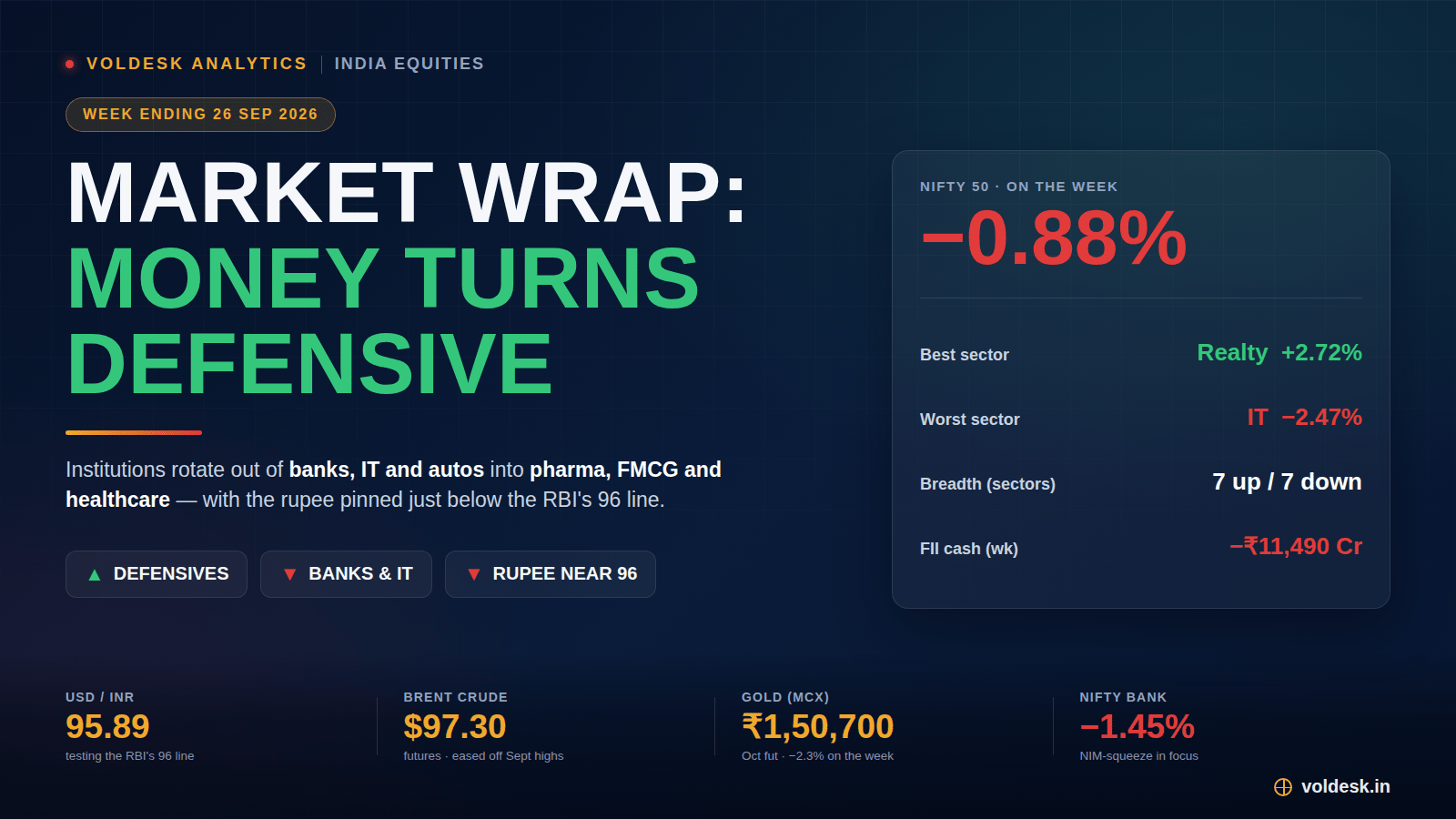
Market Wrap: Money Turns Defensive
One week after the Fed's hike, the rotation we mapped is showing up on the tape. In our post-Fed piece , we argued the move would split the …
20 Sep 2026
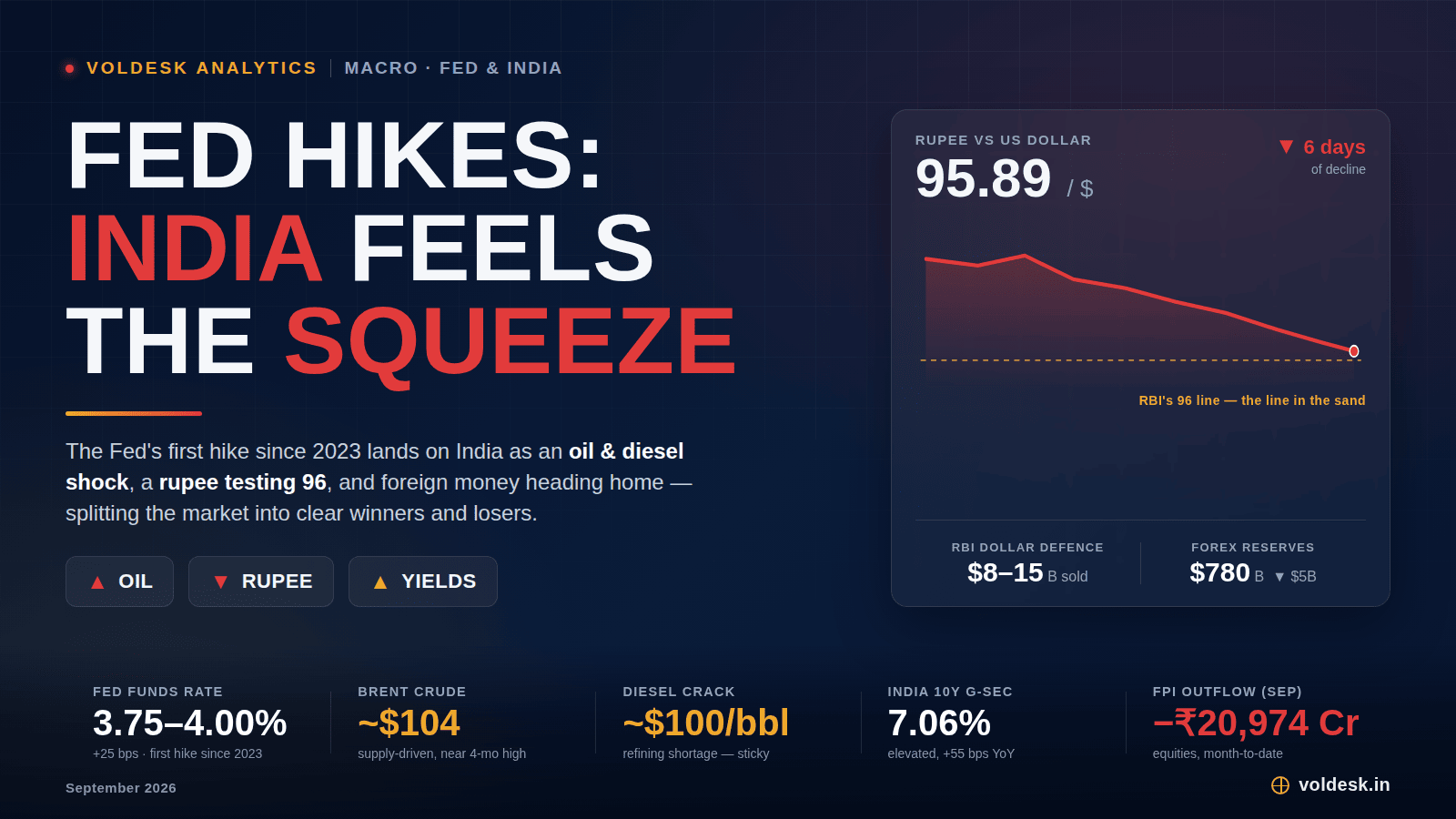
Fed Hikes: India Feels the Squeeze
On September 16, 2026, the Federal Reserve raised its target range by 25 basis points to 3.75% – 4.00% — its first hike since 2023. The trig…
Disclosure — No security recommendation. Educational market commentary. This article is for information and education only and does not constitute personalised advice. Investments in securities are subject to market risk; no returns are assured.