02 Oct 2026 · Chirag Asnani
Autos: The Crude Divide
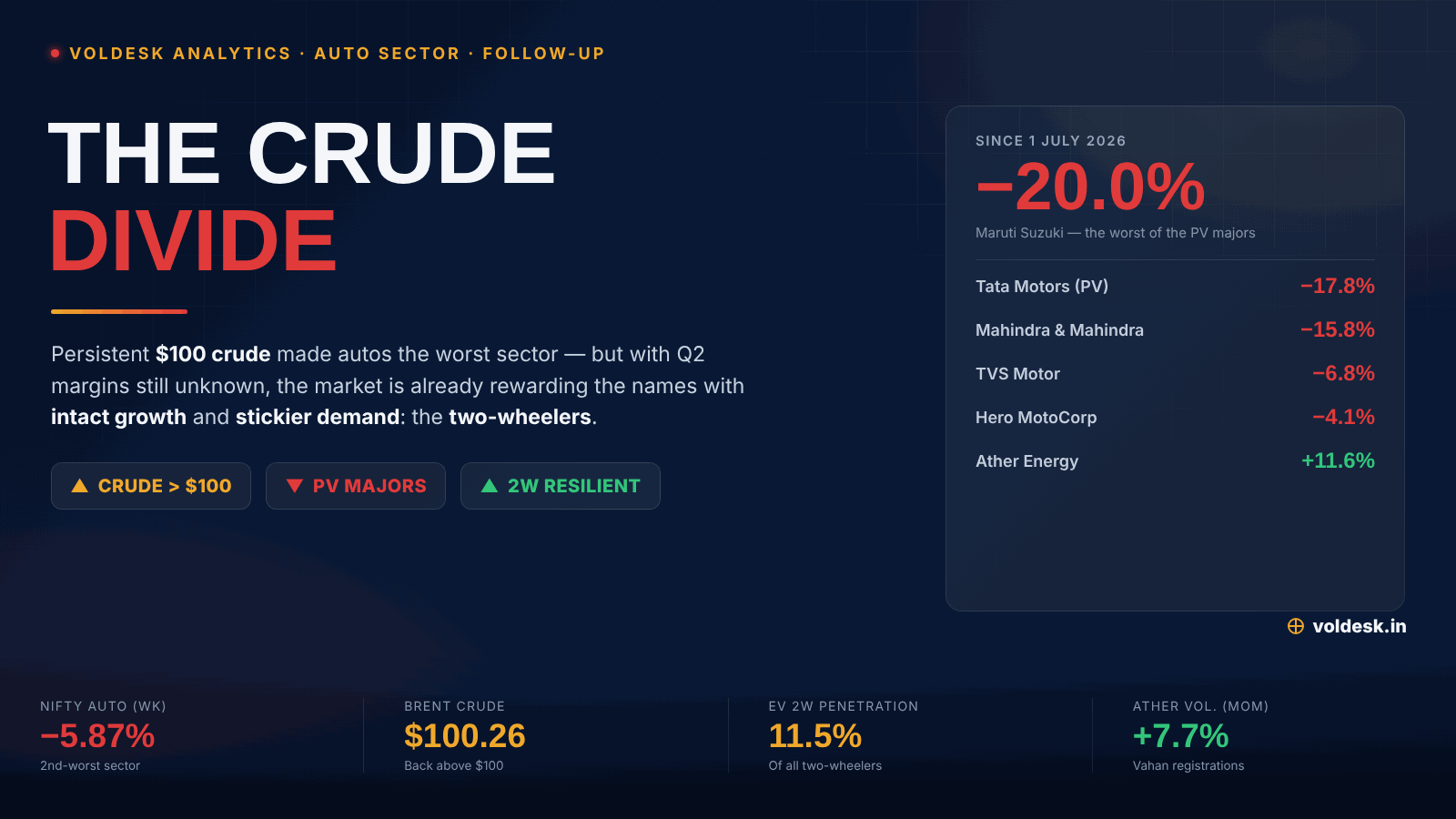
Six weeks ago, in Record Sales, Shrinking Margins, we flagged a paradox in India's auto sector: record Q1 volumes on the surface, a commodity-driven margin squeeze underneath. We left the verdict open — was the squeeze temporary, a one-quarter commodity spike, or something more durable? That verdict is still open. Q2 FY27 results are only due in the coming weeks, so no one yet knows whether the squeeze carried on. What we can see is how the market is positioning ahead of that answer — and the message is unambiguous.
With Brent crude back above $100 a barrel, the Nifty Auto index was the worst major sector last week, down 5.87%, and now sits on its weekly 100-period moving average — a level last touched in April 2025, during the tariff-war shock. But the damage is not uniform. The market is drawing a sharp line through the sector along a single fault: how exposed each business is to crude and to rate-sensitive demand.
The question Q2 will answer
We should be precise about what we know and what we don't. We do not yet know that the margin squeeze is continuing — the last reported numbers are from Q1 (the quarter to June), when operating margins fell across every major carmaker. Q2 FY27, the quarter just ended, is the one that will confirm or clear the sector, and those results are still a few weeks out. Here is the Q1 baseline the market is anchoring to:
| Carmaker | Op. margin, Q1 FY26 | Op. margin, Q1 FY27 |
|---|---|---|
| Maruti Suzuki | 12.0% | 8.2% |
| Hyundai | 13.3% | 9.1% |
| Mahindra & Mahindra | 14.3% | 12.2% |
| Tata Motors (PV) | 3.4% | 2.5% |
From here the path forks. If Q2 confirms the squeeze — plausible, given crude never cooled — margins could take a few more quarters to stabilise, and the sector stays under pressure until input costs ease. If the carmakers surprise and protect margins better than feared, the market is likely to treat the fall as overdone, re-rate the group on what would then look like cheap valuations, and a stronger bid could return quickly. Either way, the prices have already travelled a long way before the facts are in — which is exactly why the next few weeks matter.
Two-wheelers are holding up better than cars
Look beneath the index and the damage is far from even. It is concentrated in big-ticket, four-wheeler passenger vehicles — precisely the purchases most sensitive to EMIs, financing costs and a stretched household budget, and the ones with the heaviest crude-linked input bill. Two-wheelers have held up better, and the reasons are structural: a far smaller ticket size, demand that is stickier because a scooter or motorcycle is closer to a necessity than a discretionary upgrade, and a customer less exposed to the financing pinch that is hurting car demand.
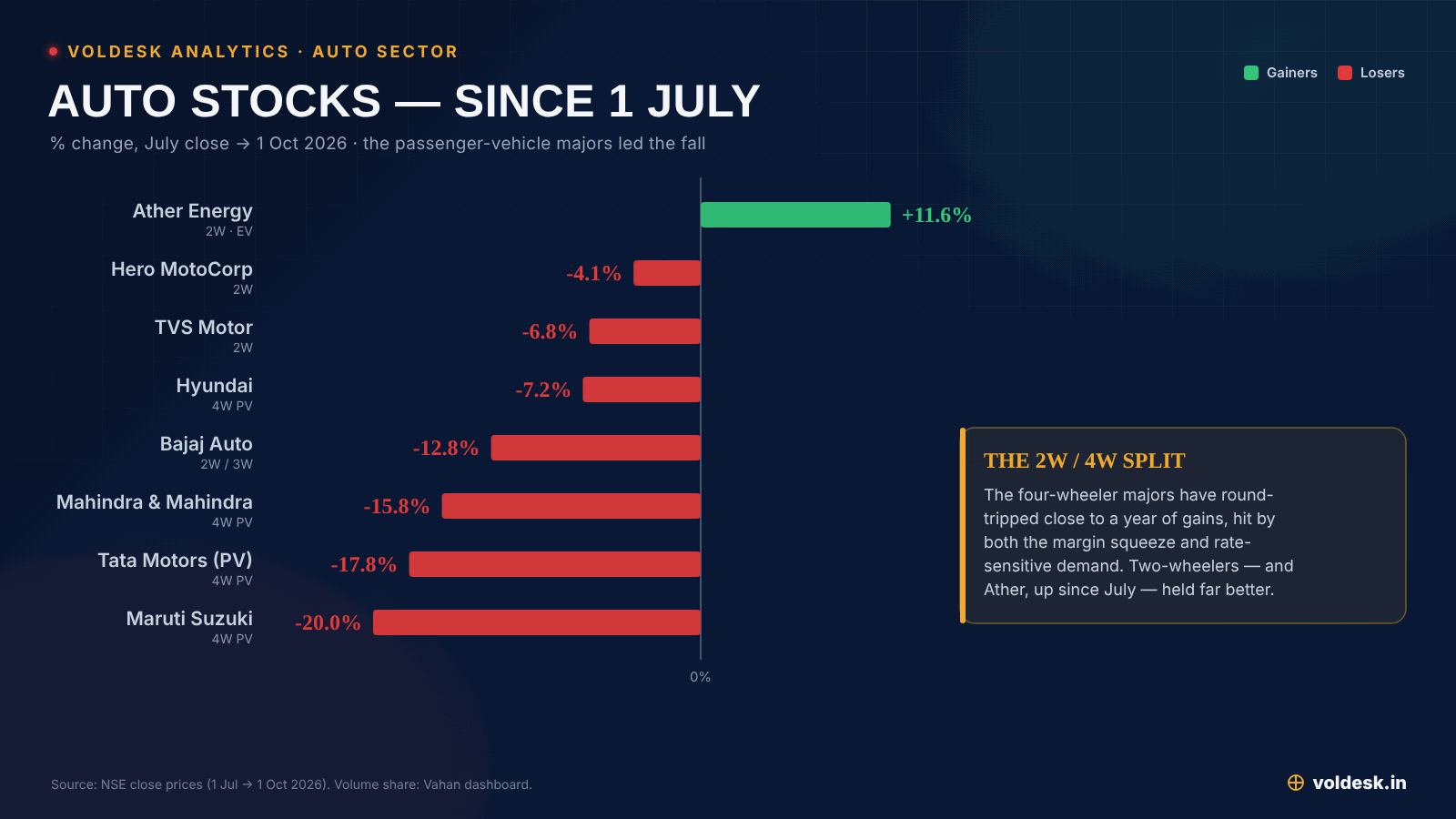
The scoreboard since the start of July makes the split plain. The four-wheeler majors are the worst of the group, while the two-wheeler and growth names have lost far less — or, in one case, gained.
| Stock | 1 Oct (₹) | Last week | Since 1 Jul |
|---|---|---|---|
| Ather Energy | 1,406 | −6.08% | +11.6% |
| Hero MotoCorp | 5,168 | −3.58% | −4.1% |
| TVS Motor | 4,021 | −3.28% | −6.8% |
| Hyundai | 2,024 | −4.30% | −7.2% |
| Bajaj Auto | 10,045 | −10.96% | −12.8% |
| Mahindra & Mahindra | 2,860 | −5.77% | −15.8% |
| Tata Motors (PV) | 279.40 | −3.80% | −17.8% |
| Maruti Suzuki | 11,386 | −5.63% | −20.0% |
Where growth is still intact
Two names stand apart. Ather Energy is the clearest. Even after a 6% pullback last week, it is still up double digits since July — a give-back of a strong run, not a demand problem. The volume picture backs that up: Ather's registrations rose about 7.7% month-on-month on the Vahan dashboard (vahan.parivahan.gov.in), it ranks third by market share in electric two-wheelers, and EV penetration of the overall two-wheeler market is now around 11.5% and still climbing. The one caveat is price: Ather still trades well above most street fair-value estimates, so the stock can stay volatile even while the business compounds — the growth is real, the valuation leaves little room for error.
TVS Motor and Hero MotoCorp are the quieter version of the same story. The two-wheeler majors held up far better than the cars — TVS was the most resilient of the autos last week (−3.28%), and Hero has given up only about 4% since July, against 16–20% for the passenger-vehicle leaders. The logic is the same: a two-wheeler-heavy mix, a smaller ticket and steadier volumes. Where the four-wheeler majors are fighting both a possible margin squeeze and rate-sensitive demand, the two-wheeler franchises are fighting less of each — and the ones still growing volumes are barely fighting at all.
The scorecard
- The verdict is still pending: Q2 FY27 results — not yet out — will confirm or clear the margin squeeze.
- Crude is the swing factor: back above $100, it is why autos led the fall and why the market is nervous into results.
- The split is 2W over 4W: smaller ticket, stickier demand, and less crude and rate exposure.
- Growth is being rewarded: Ather and TVS have held up — though Ather's valuation stays rich.
The bottom line
Strip away the noise and the week carried one clear message: the market is rewarding businesses where growth is intact or contained — those with less exposure to crude and with stickier, smaller-ticket demand. That is why the two-wheelers, and Ather above all, have held their ground while the big four-wheeler names took the brunt. The margin question itself will only be settled when Q2 FY27 lands; until then, the sector is being traded not on what margins did, but on who looks best insulated from the two forces pressing on it — the price of crude and the cost of money.
Keep reading
01 Oct 2026
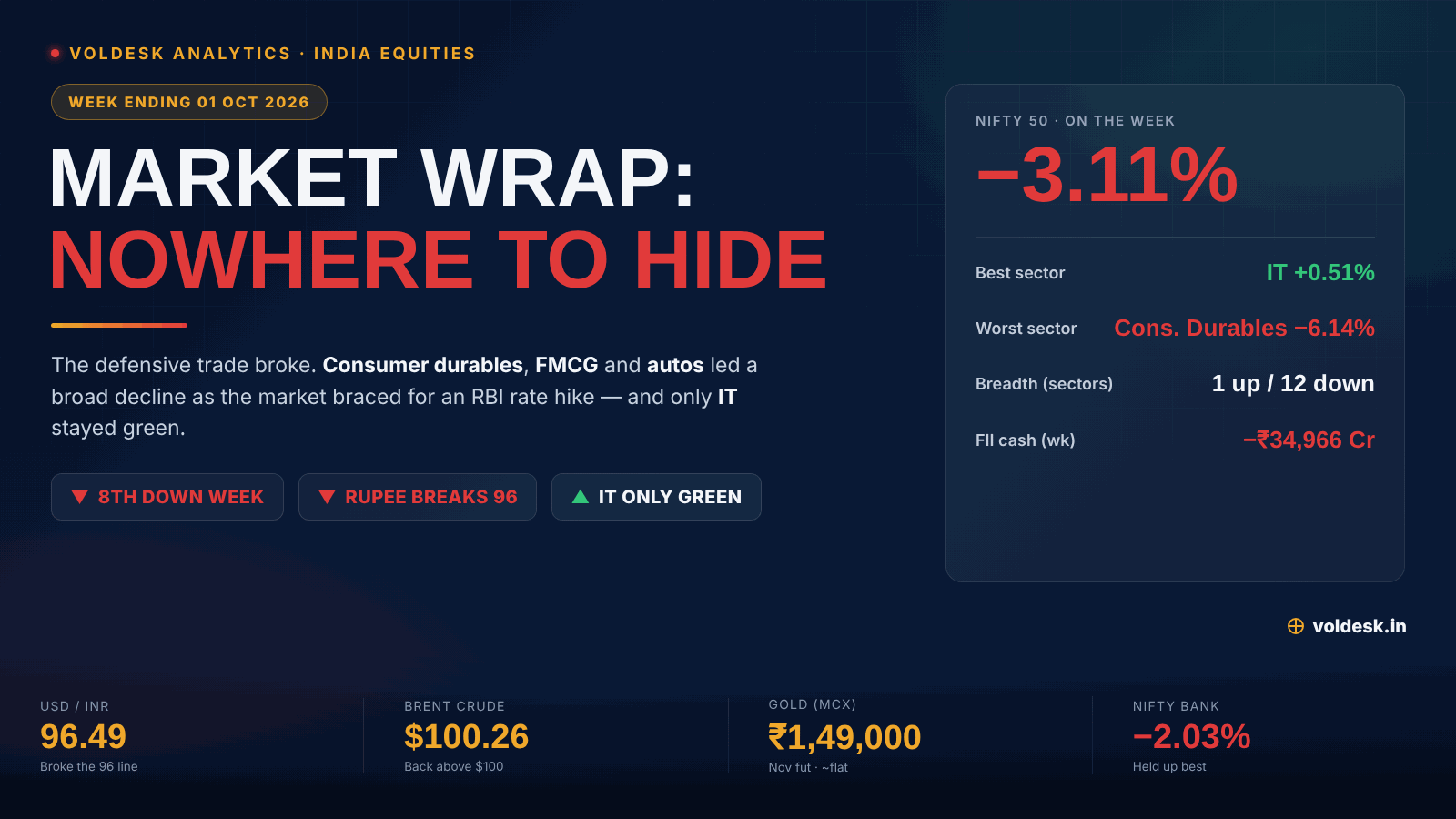
Market Wrap: Nowhere to Hide
Last week we framed it as Money Turns Defensive — money rotating out of rate-sensitive sectors into the shelter of FMCG, pharma and healthca…
26 Sep 2026
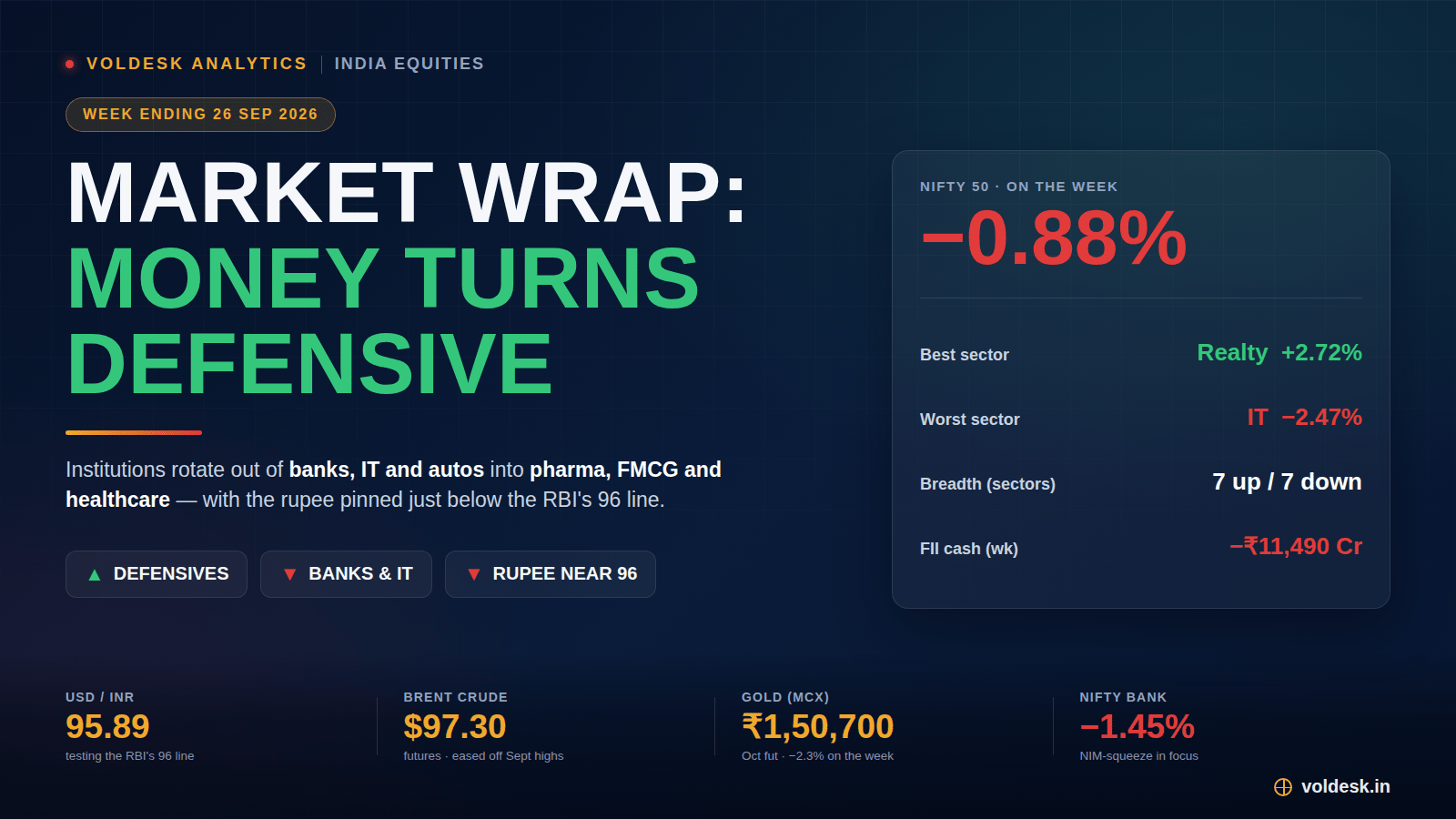
Market Wrap: Money Turns Defensive
One week after the Fed's hike, the rotation we mapped is showing up on the tape. In our post-Fed piece , we argued the move would split the …
20 Sep 2026
Fed Hikes: India Feels the Squeeze
On September 16, 2026, the Federal Reserve raised its target range by 25 basis points to 3.75% – 4.00% — its first hike since 2023. The trig…
Disclosure — No security recommendation. Macro commentary. This article is for information and education only and does not constitute personalised advice. Investments in securities are subject to market risk; no returns are assured.