22 Aug 2026 · Chirag Asnani
Record Sales, Shrinking Margins: The GST Boom Hiding a Squeeze in India's Carmakers
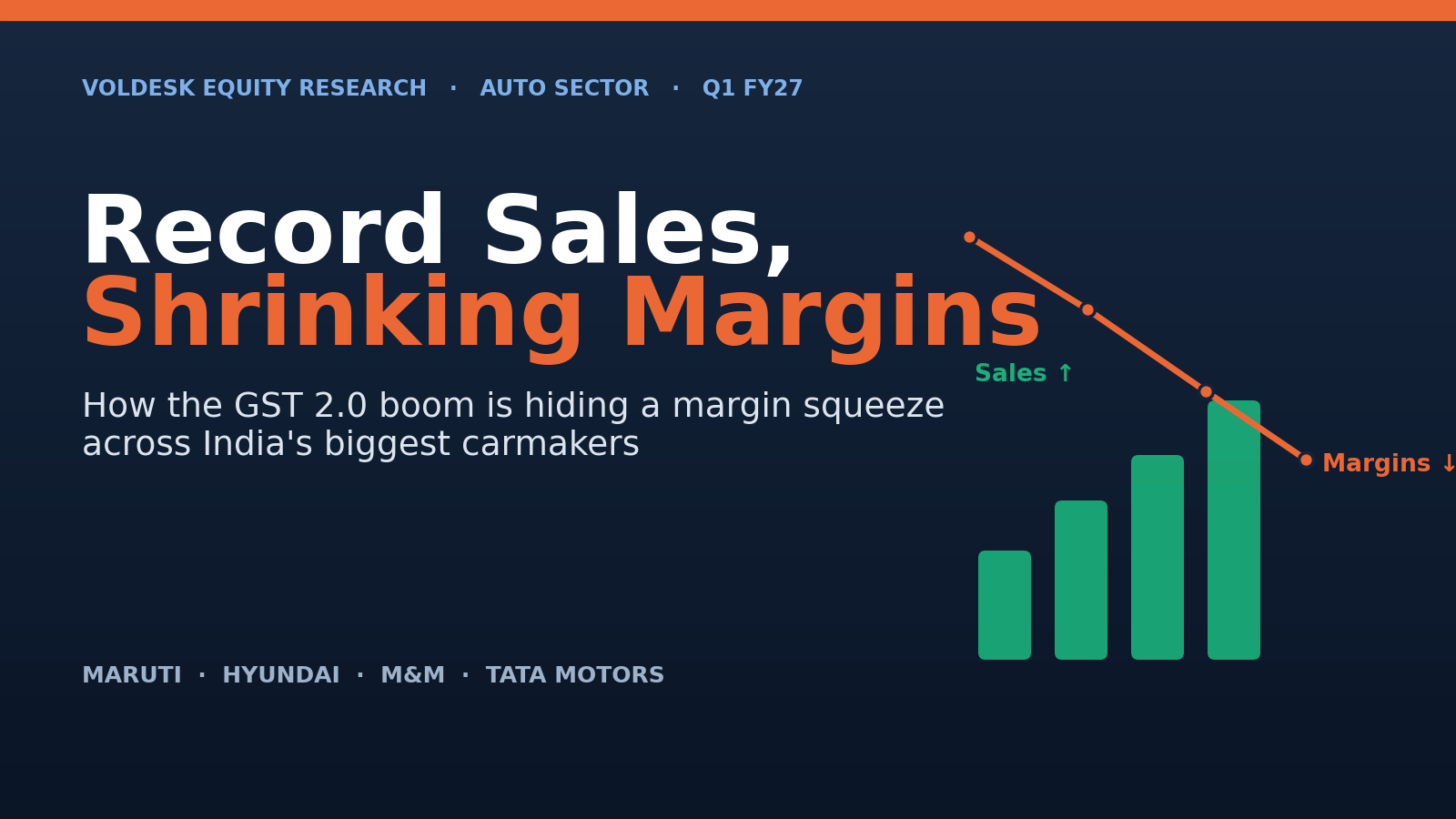
Something odd happened to India's car industry in the April–June 2026 quarter. Carmakers sold more vehicles than in any first quarter in their history — and still earned less profit than a year earlier. If that sounds contradictory, it is the most important thing to understand about the auto sector right now. A tax cut pushed sales to record highs, while a conflict thousands of kilometres away quietly pushed up costs and squeezed what companies keep on every car they make. This article walks through both halves of that story, in plain language.
First, the good news: cars flew off the lots
The headline numbers were genuinely strong. According to SIAM, the industry body, passenger-vehicle sales hit an all-time Q1 record of 1.27 million units — up 25.9% versus the same quarter last year. Two-wheelers, three-wheelers and commercial vehicles all grew in double digits too.
The main reason is GST 2.0. In simple terms, the government lowered the Goods and Services Tax on many vehicles — small cars, for example, moved into an 18% slab instead of an effective ~40% earlier. A lower tax means a lower on-road price, which pulls hesitant customers into showrooms. SIAM itself credited "lower GST rates, softer financing costs, a low base and new model launches." A notable share of these customers were first-time owners — exactly the group a price cut brings in. So the demand was real. The catch is what that demand did (and did not do) to profits.
Now the catch: every carmaker earned a thinner margin
A quick word on "margin," because it is the heart of this story. The number to watch is the operating margin (often called the EBITDA margin): out of every ₹100 of sales, how much is left after the day-to-day cost of making and delivering the vehicles — before interest, tax and depreciation. A falling margin means the company keeps less of each rupee it earns, even if total sales are rising.
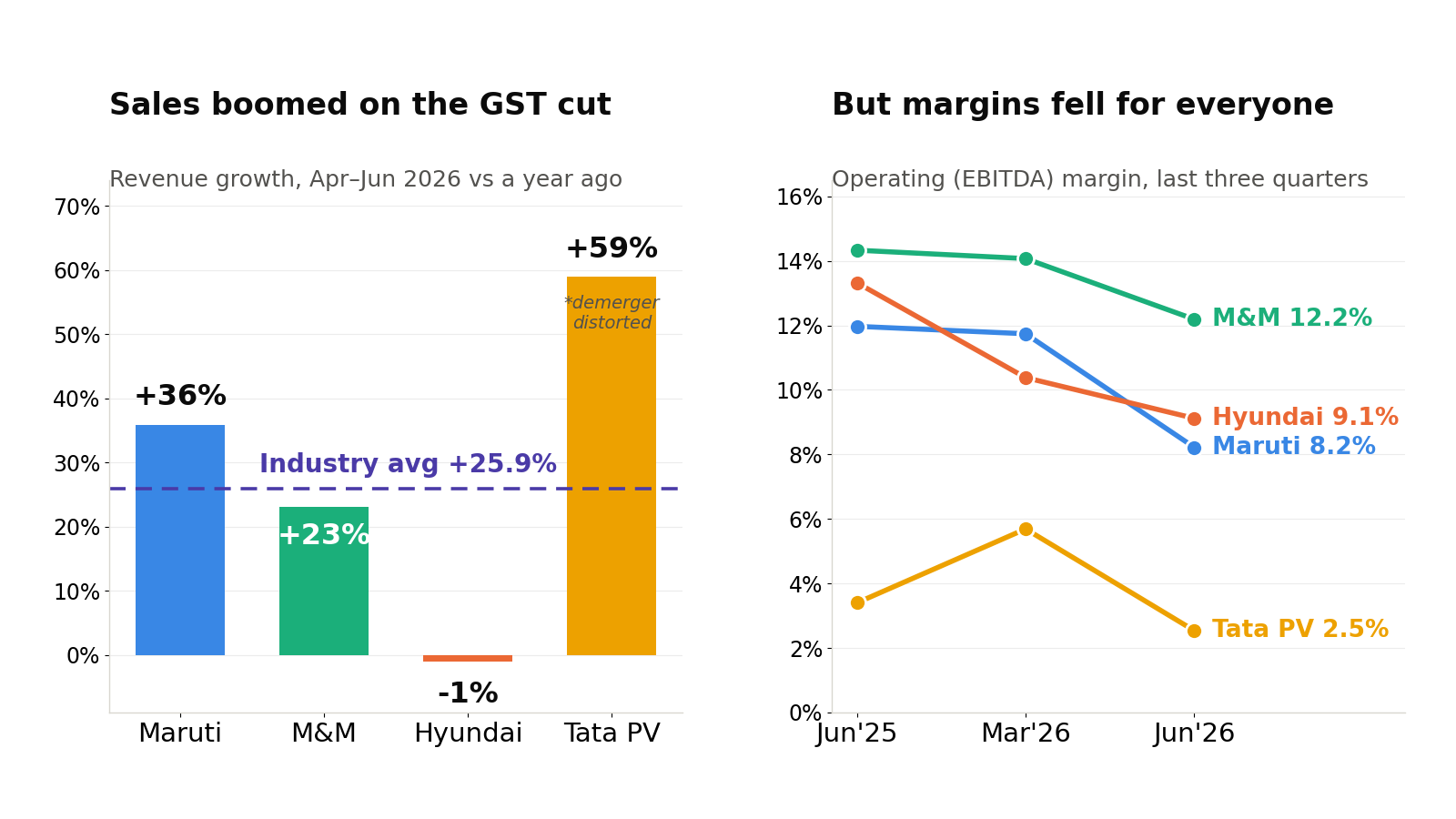
And in this quarter, the operating margin fell for all four of India's biggest listed carmakers. That is the tell. When one company slips, it is usually a company problem; when every company slips at once, it is a cost problem hitting the whole industry.
| Company (operating margin) | Jun '25 | Mar '26 | Jun '26 |
|---|---|---|---|
| Maruti Suzuki | 12.0% | 11.7% | 8.2% |
| Hyundai India | 13.3% | 10.4% | 9.1% |
| Mahindra & Mahindra | 14.3% | 14.1% | 12.2% |
| Tata Motors PV | 3.4% | 5.7% | 2.5% |
The bottom line proves the point. Maruti's revenue grew about 36% from a year earlier, yet its net profit fell roughly 11%. Hyundai's profit dropped about 34%. Only Mahindra managed to grow profit. When sales are up sharply and profit is down, the margin is the story — not the sales figure everyone is celebrating.
Why margins shrank: a distant conflict raised costs at home
Every company pointed to the same culprit on its earnings call: commodity costs, driven up by the West Asia (Iran–US) conflict during the quarter. War in that region lifts crude oil, and crude feeds into plastics, paints, rubber and tyres. It also disrupted shipping and pushed up metals — steel, aluminium, copper — and precious metals like palladium used in vehicles. All of that lands directly on a carmaker's cost sheet.
The size of the hit was large. Maruti said commodities cost it about 300 basis points of margin in one quarter (a "basis point" is one-hundredth of a percentage point, so 300 bps = 3 percentage points). Tata flagged a similar hit and warned of more to come in the current quarter. Hyundai pointed to precious metals and copper, plus the war hurting its exports. Mahindra cited steel and rubber. Same storm, hitting everyone.
Here is the encouraging part: much of this looks temporary rather than permanent. Some of the cost was one-off timing (Maruti chose to pay its suppliers faster to keep the supply chain running), some was seasonal, and metal prices such as aluminium have already eased from their peaks. Carmakers have also begun raising prices in small, calibrated steps to claw the margin back over the next few quarters.
Same storm, different boats
Because the GST cut lifted the whole market, a rising sales line tells you little about who is actually winning. The revealing question is: who grew faster than the industry's 25.9%?
Only Maruti (about +36%) and Mahindra (about +23%) beat the market — and Maruti even gained market share, crossing 41%. Strikingly, Hyundai's revenue actually fell around 1% in a record quarter, and Tata's passenger-vehicle revenue slipped versus the prior quarter. In other words, the rising tide did not lift every boat equally. On the health of the margins themselves: Mahindra looks the most comfortable (still above 12%); Maruti and Hyundai have dropped to multi-quarter lows, with Hyundai now below its own full-year guidance; and Tata's India car business is running at wafer-thin, near-breakeven margins.
What the stock market already believes
Share prices moved before the results did. As the conflict and cost fears built, auto stocks sold off from their late-February levels to a low, then recovered as sentiment settled. Comparing that price journey with the margin damage now confirmed in the results tells us how much bad news is already "priced in."
| Stock | Fall to low | Now vs pre-fall | Margin (YoY) |
|---|---|---|---|
| Hyundai | −21.9% | +2.5% | worst |
| Maruti | −17.2% | −8.7% | weak |
| Mahindra | −13.7% | +0.4% | mildest |
| Tata Motors PV | −22.6% | −16.4% | thinnest |
Three of the four line up sensibly. Mahindra has fully recovered its price, which fits its mild margin hit and continued profit growth. Tata remains well below where it started, in line with its genuinely thin margins. Maruti's margin decline appears more recoverable than some peers — much of its cost hit was one-off timing and it is gaining share — but Q2 will determine whether that pressure was genuinely transient.
The odd one out is Hyundai. Its share price has fully round-tripped to above pre-fall levels, even though it delivered the worst margin fall in the group and its revenue actually shrank. In other words, there is a visible gap between what the results now show and what the price reflects — an observation worth watching over the coming quarters, rather than a conclusion in itself.
The bottom line, and what to watch next
The tidy headline — "auto sales hit record highs" — is true but incomplete. GST 2.0 supercharged the sales line, while a commodity shock quietly compressed profit margins at every carmaker. The real debate is how much of that squeeze is temporary. The next few data points, in the order they will arrive, should settle it:
- August sales numbers (out early September). The first check on whether demand is still strong or whether the GST cut simply pulled forward purchases that would have happened later.
- Do the price hikes stick? Carmakers raised prices in small steps through the quarter. Watch whether those increases hold without denting the GST-driven demand — that is how margins start to recover.
- Are commodity prices cooling? Aluminium and some metals are off their peaks, which would ease the pressure. But Tata has warned of a further cost hit, so this needs confirming, not assuming.
- Do the supply-chain disruptions ease? If the West Asia situation stabilises, shipping and input flows normalise and the one-off costs fade.
- The next quarter's results (Jul–Sep 2026). The decisive test — two questions at once: is festive-season demand still there, and is margin recovery actually showing up in the numbers?
For now, the sector is a study in contrasts: record volumes on the surface, a cost squeeze underneath, and a market that has already priced the damage into every name except Hyundai. The next quarter is where the "temporary or not" question gets answered.
This is the short, public version. Our full research report on this theme goes much deeper — company-by-company margin bridges, valuation detail, and the complete "how much is priced in" analysis. To get our in-depth research reports like this delivered free, subscribe to the VolDesk email newsletter.
References & further reading
- SIAM — Auto Industry Sales Performance, Q1 FY27 (April–June 2026), released 15 July 2026.
- Maruti Suzuki India — Q1 FY27 unaudited financial results and earnings-call transcript.
- Hyundai Motor India — Q1 FY27 financial results and earnings-call transcript.
- Mahindra & Mahindra — Q1 FY27 standalone results and earnings-call transcript.
- Tata Motors Passenger Vehicles — Q1 FY27 standalone results and earnings-call transcript.
- screener.in — share prices, valuation ratios and quarterly financials (as at 20–21 August 2026).
Keep reading
02 Oct 2026
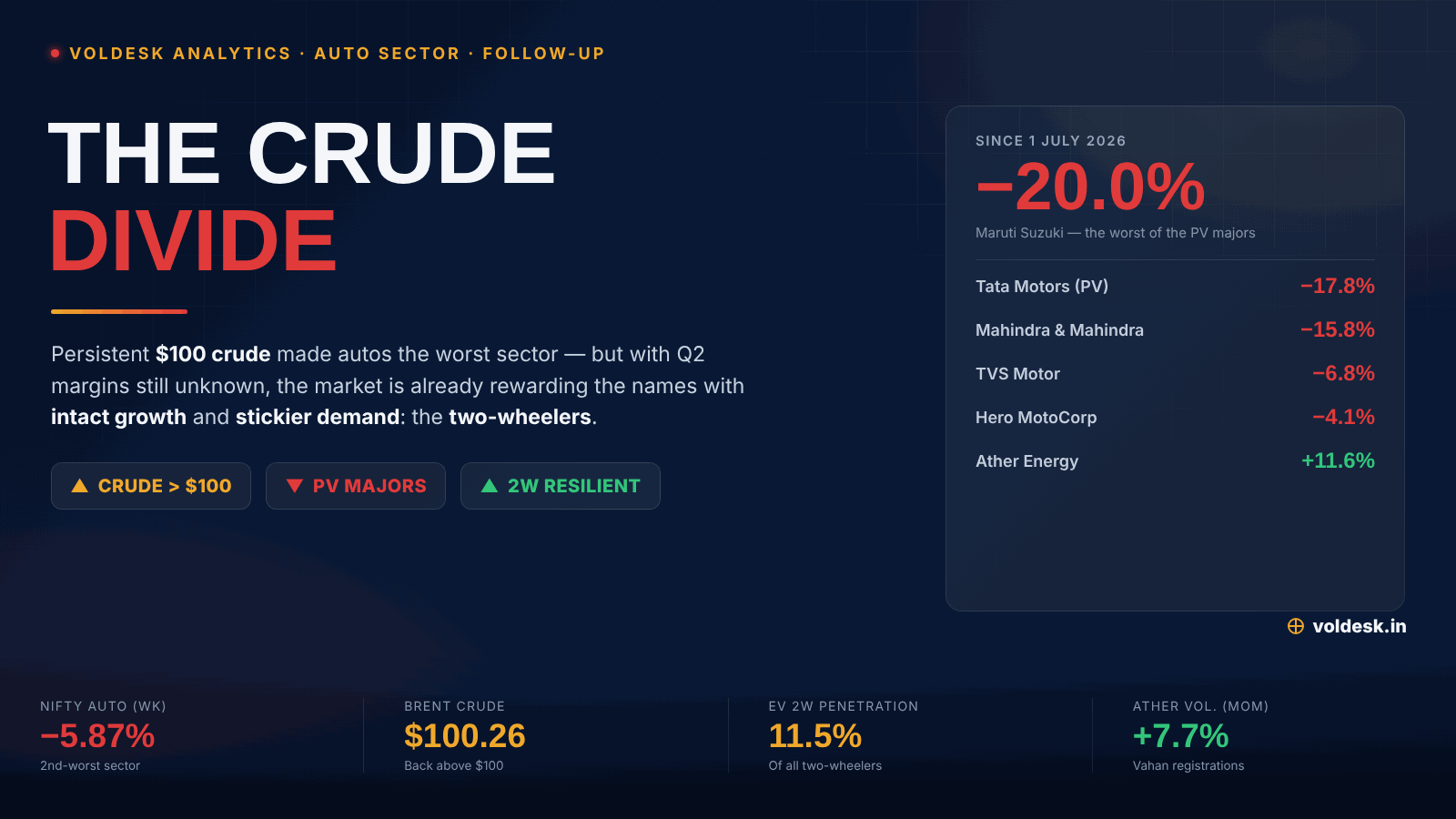
Autos: The Crude Divide
Six weeks ago, in Record Sales, Shrinking Margins , we flagged a paradox in India's auto sector: record Q1 volumes on the surface, a commodi…

01 Oct 2026
Market Wrap: Nowhere to Hide
Last week we framed it as Money Turns Defensive — money rotating out of rate-sensitive sectors into the shelter of FMCG, pharma and healthca…

26 Sep 2026
Market Wrap: Money Turns Defensive
One week after the Fed's hike, the rotation we mapped is showing up on the tape. In our post-Fed piece , we argued the move would split the …
Disclosure — Educational market commentary only. Not a recommendation to deal in any security. Figures are drawn from company filings, earnings calls, SIAM and public sources as at the date of publication and may change. This article is for information and education only and does not constitute personalised advice. Investments in securities are subject to market risk; no returns are assured.