26 Sep 2026 · Chirag Asnani
Market Wrap: Money Turns Defensive
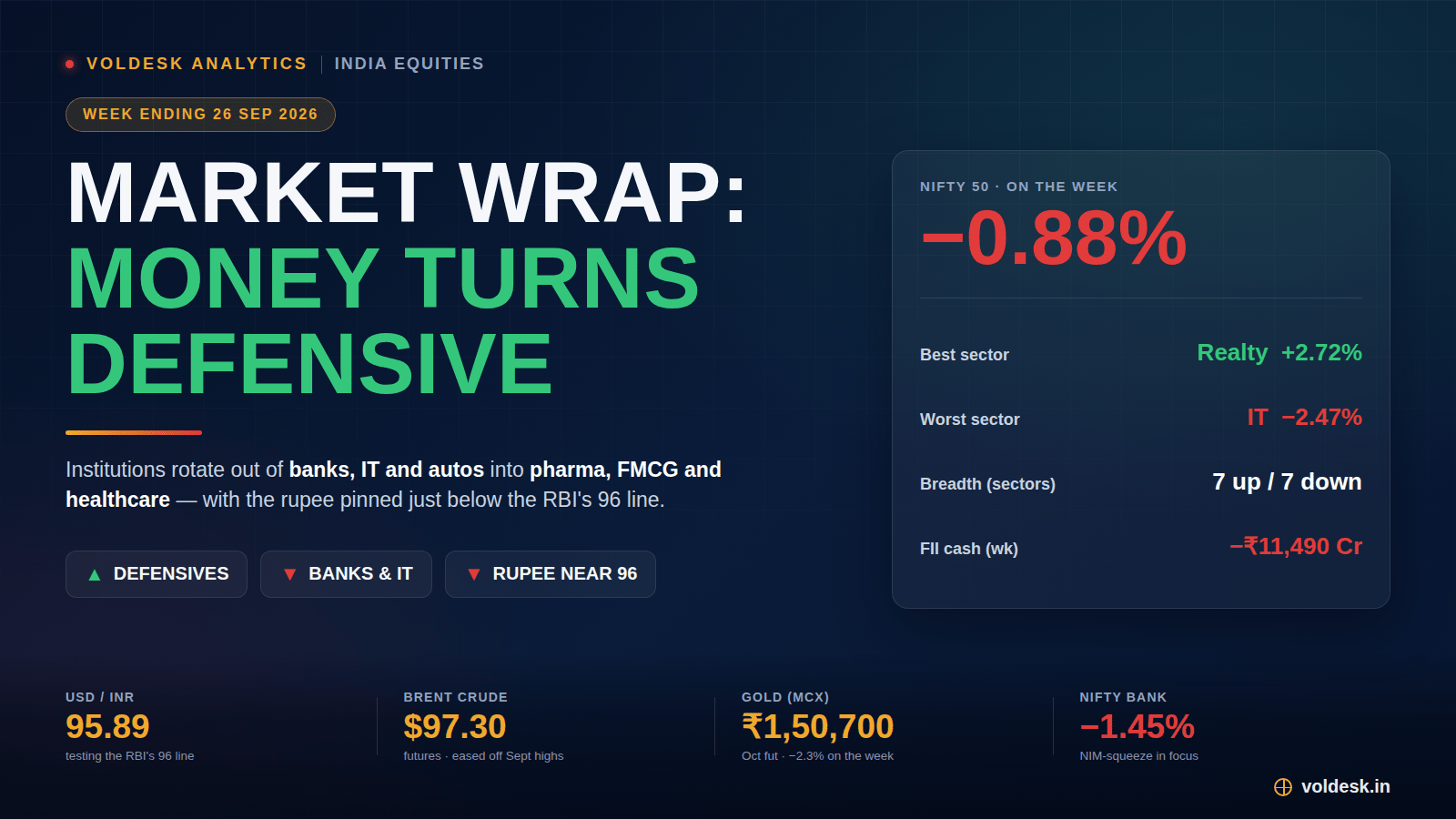
One week after the Fed's hike, the rotation we mapped is showing up on the tape. In our post-Fed piece, we argued the move would split the market — flagging banks, IT and autos as the rate- and inflation-sensitive losers, and defensives like FMCG, pharma and healthcare, where demand doesn't ride on the cost of money, as better placed. Between September 18 and 25, the Nifty 50 slipped just 0.88%, and the sector tape voted almost exactly along those lines.
Sectors — the tape
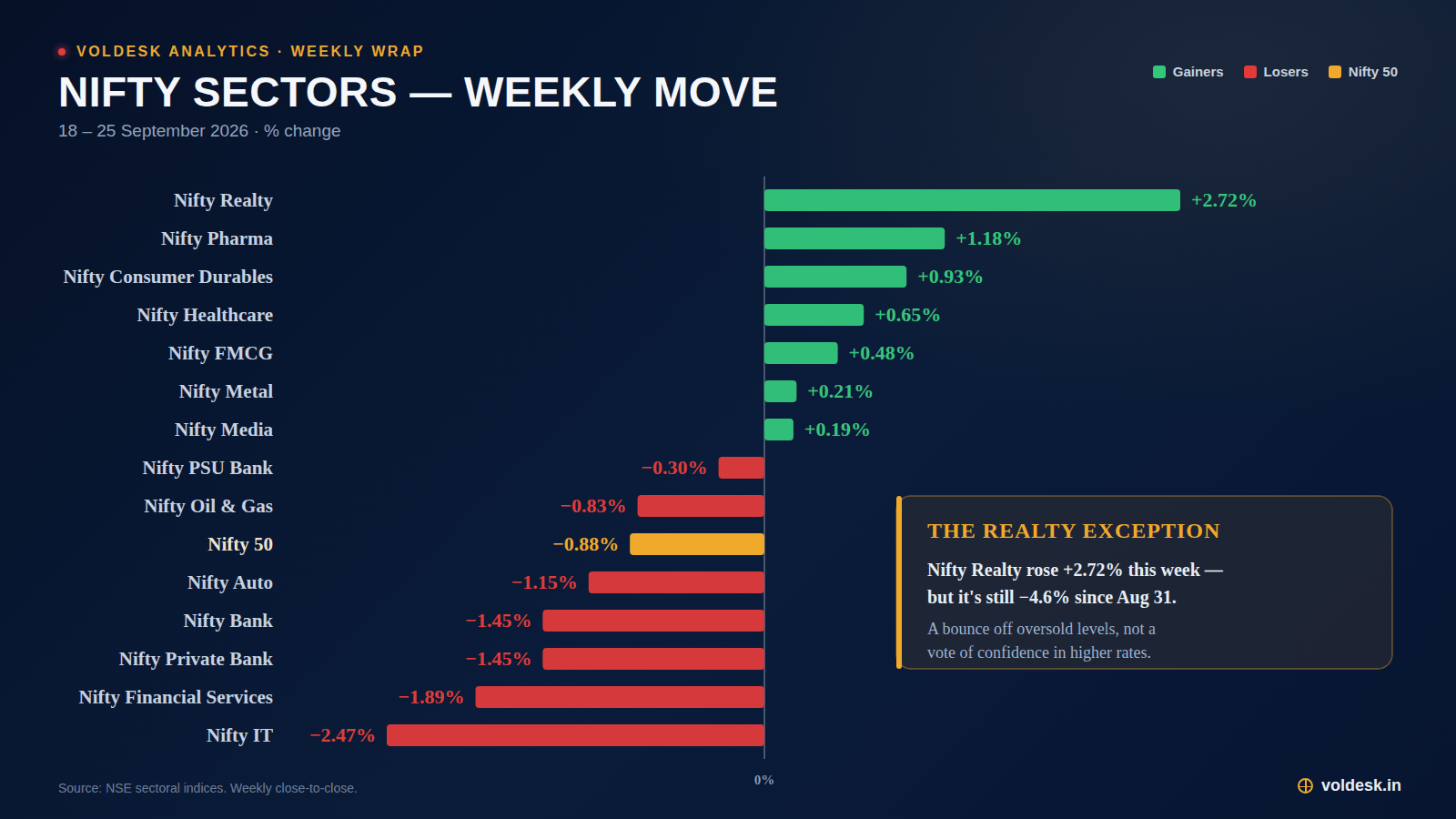
The split is clean. Every rate- and inflation-sensitive corner was under pressure, while defensives held green. Nifty IT was the worst performer, down 2.47% — the most telling move of the week. A weak rupee is a mechanical tailwind for IT margins, yet the sector was hit hardest, because the market is looking straight through the currency benefit to weak demand and soft revenue growth. The financials followed: Nifty Financial Services −1.89%, with Nifty Bank and Nifty Private Bank both off 1.45%. Nifty Auto (−1.15%) and Nifty Oil & Gas (−0.83%) rounded out the red.
On the other side sat the defensive shopping list: Nifty Pharma led all sectors at +1.18%, with Nifty Healthcare (+0.65%) beside it; Nifty FMCG added 0.48% and Nifty Consumer Durables 0.93%. FMCG is doing this from a position we highlighted last week — its cheapest valuation in a decade, the COVID crash aside. Seven sectoral indices closed higher and seven lower, but the heavier weights sat on the losing side, which is why the Nifty still ended down.
The one apparent outlier is Nifty Realty, up 2.72% and the week's best performer, despite being about as rate-sensitive as a sector gets. But realty already did its falling: it is still down roughly 4.6% since August 31, with the pain front-loaded into early September. This week's move is a bounce off oversold levels, not a vote of confidence in higher-for-longer rates.
Spotlight: the banks
Under the surface, the pressure on banks was uneven. Among the heavyweights, only HDFC Bank held green, up 0.49% — its scale and low-cost deposit franchise exactly the stability investors want when funding costs are rising. The rest fell, and the private names led lower: Axis Bank −3.72% and Kotak Mahindra −2.67% were the worst, with SBI −1.67% and ICICI Bank −0.85%. The pattern fits the NIM-squeeze story — the banks most exposed to deposit repricing took the hardest hits, while the largest, most deposit-rich franchise was spared.
| Bank | 18 Sep | 25 Sep | % Change |
|---|---|---|---|
| HDFC Bank | ₹731.00 | ₹734.55 | +0.49% |
| ICICI Bank | ₹1,338.90 | ₹1,327.50 | −0.85% |
| SBI | ₹996.20 | ₹979.55 | −1.67% |
| Kotak Mahindra Bank | ₹412.50 | ₹401.50 | −2.67% |
| Axis Bank | ₹1,257.00 | ₹1,210.20 | −3.72% |
Macro backdrop: oil, rupee, gold, yields
The cross-asset picture was, for once, a mild relief on inflation — but not on flows. Commodities cooled: Brent crude eased to around $97.30, back off its September highs, and gold pulled back too, with MCX October futures down about 2.3% on the week to ₹1,50,700 per 10g after a strong run. The rupee, however, stayed under pressure — USD/INR held at ~95.89, pinned just below the 96 line the RBI continues to defend. And the real driver sat in the US: the 10-year Treasury yield pushed to 5.19% (as of writing, ~12:30 AM, September 26), a fresh high that keeps global money flowing toward the dollar and away from emerging markets.
| Asset | Level | On the week |
|---|---|---|
| Brent crude | $97.30 | Eased, off September highs |
| USD/INR | 95.89 | ~Flat; pinned below RBI's 96 line |
| Gold (MCX Oct fut) | ₹1,50,700/10g | −2.3% (from ₹1,54,290 on 18 Sep) |
| US 10-Yr Treasury | 5.19% | Fresh high (as of writing) |
Foreign flows
The flow data underlines the story. Foreign investors were net negative in the cash market for the week, pulling out ₹11,490 crore. With US yields at 5.19% and the rupee soft, the incentive to repatriate is strong — and until that reverses, the pressure on India's high-beta sectors is unlikely to lift.
Global & macro watch
- Fed still hawkish: September's hike to 3.75–4.00% and a dot-plot pointing to one more move keep global liquidity tight and the dollar firm.
- US yields at a fresh high: the 10-year at 5.19% is the single biggest headwind for EM flows right now.
- Commodities cooled: both crude and gold eased, a small relief on India's import and inflation math.
- All eyes on the RBI (Oct 5–7): with the rupee at 96, does it hold at 5.25% or lean hawkish to defend the currency?
- FIIs still exiting: ₹11,490 crore of cash-market outflows on the week.
The week ahead
The RBI's October 5–7 policy is the main event. A hold keeps the defensive bias intact; any hawkish tilt to defend the rupee would deepen the pressure on rate-sensitive sectors. Watch the 96 level on USD/INR, US yields around 5%, and whether FII outflows slow.
The bottom line
A single week is a signal, not a verdict — but this one lined up cleanly with the fundamentals, and with the call we made last week. The rate- and inflation-sensitive sectors came off, the defensives held up, foreign money kept leaving, and the one glaring exception, Realty, is a sector that had already taken its hit. Until US yields cool or the rupee stabilises, the market is telling you where it thinks safety lies — and it isn't in the sectors that ride on borrowed money.
Keep reading
20 Sep 2026
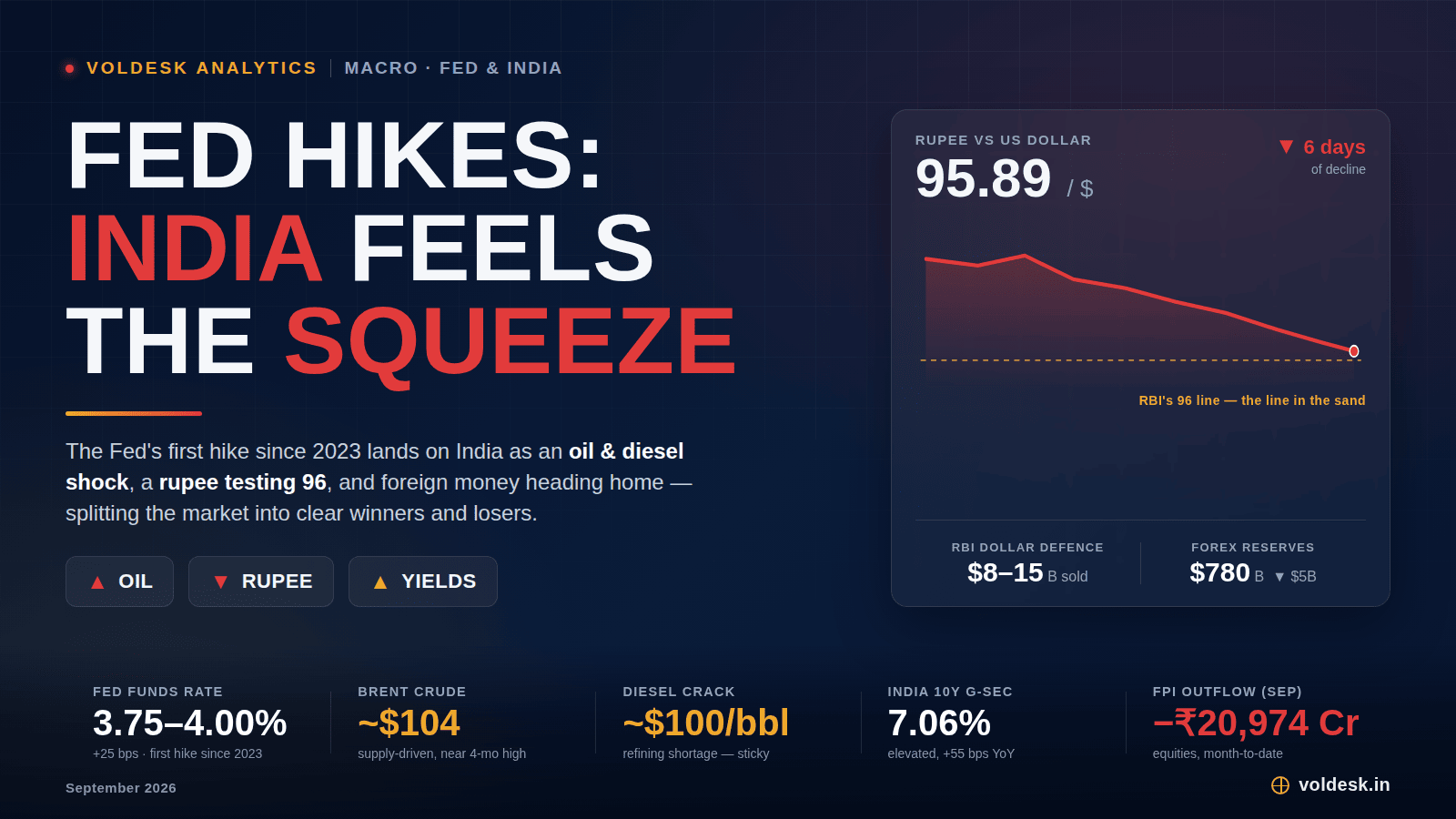
Fed Hikes: India Feels the Squeeze
On September 16, 2026, the Federal Reserve raised its target range by 25 basis points to 3.75% – 4.00% — its first hike since 2023. The trig…

09 Sep 2026
Rentomojo: India's First Listed Rental Play — Good Company, Fair Value?
For the first time, Indian public markets get to price a furniture-and-appliance rental platform . Rentomojo Limited opens its ₹1,256 crore …

09 Sep 2026
Tempsens: The Manufacturing-Leader Premium, Already Priced In?
Tempsens Instruments (India) priced its IPO at ₹300 — roughly 35x earnings — listed on 28 August 2026 and closed its first day at ₹586.65 , …
Disclosure — No security recommendation. Educational market commentary. This article is for information and education only and does not constitute personalised advice. Investments in securities are subject to market risk; no returns are assured.