30 Jul 2026 · Chirag Asnani
Hawkish Hold: the Fed pauses, but the bond market is already pricing a hike
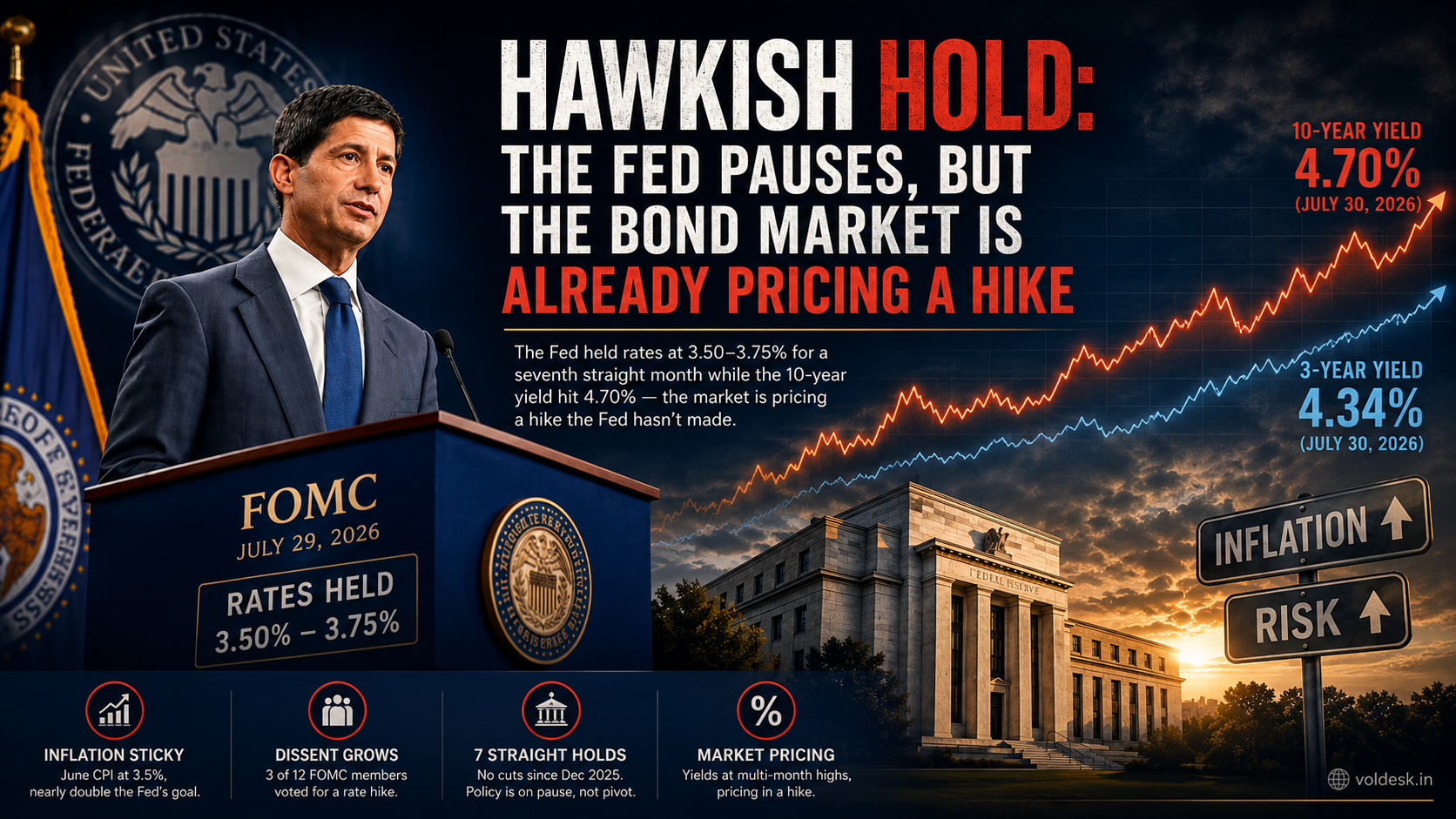
The Federal Reserve did nothing on July 29 — and that, paradoxically, was the loudest thing it could have done. The July hold extends an unbroken streak: the Fed has kept rates frozen at every monthly meeting since January 2026, with no cut delivered since December 2025. Each successive pause has confirmed what the bond market had been signaling for months — the fight against inflation is not over, and the market thinks the Fed is behind it.
This piece breaks the meeting into two parts. Part 1 covers what the Fed said. Part 2 covers how the bond market has been voting with real money over the last several months — including the table that shows exactly how wide the gap has become.
Part 1 — What the Fed said
The decision: no cut. The Fed left the target range unchanged at 3.50% – 3.75%. The easing cycle — four consecutive 25 bps cuts running from late 2024 through December 2025 — has been over for seven months. Since January 2026 the Fed has held steady at every monthly meeting, and July was simply the latest in that run. This is a standing pause, not a pivot back to easing.
The message: resolve, not relief. The Chair struck a distinctly hawkish tone, stating the Fed "will not hesitate to act" to bring inflation back to its sub-2% goal. The subtext was clear — "act" now points toward holding, or even hiking, rather than cutting.
The reality check. That resolve is set against uncomfortable data. June 2026 CPI came in at 3.5%, nearly double the Fed's goal. With inflation running this hot, the Fed has little room to justify further easing without losing credibility.
The crack in the room. In a notable shift, 3 of the 12 FOMC members openly dissented in favour of a rate hike at this meeting. That is a meaningful minority — and a signal that internal pressure is building toward tighter, not looser, policy.
Part 2 — How the bond market reacted
While the Fed spent the last several months cutting and then pausing, the bond market moved in the opposite direction. Yields on both the 3-Year and 10-Year Treasuries climbed significantly, effectively overriding the Fed's easing. The 3-Year in particular has been grinding higher since the onset of the US–Iran war, as energy-driven inflation fears took hold.
The table below tracks each Fed action against what the market actually did with yields. Note the pattern: the Fed cuts or pauses, and yields rise anyway.
| Date | Fed Action | Fed Rate (After / Current) | 3-Yr Yield | 10-Yr Yield | Market Reaction |
|---|---|---|---|---|---|
| Dec 18, 2024 | −25 bps | 4.25% – 4.50% | 4.35% | 4.42% | Strong growth and robust retail data pushed both yields up, shrugging off the Fed's easing. |
| Sep 17, 2025 | −25 bps | 4.00% – 4.25% | 3.95% | 4.21% | Short yields dipped below 4% on temporary normalization; long yields stayed high on sticky inflation. |
| Oct 29, 2025 | −25 bps | 3.75% – 4.00% | 4.10% | 4.48% | Middle East friction lifted oil prices, driving a sharp "bear steepening" of the curve. |
| Dec 10, 2025 | −25 bps | 3.50% – 3.75% | 4.23% | 4.61% | Yields rose across the board as markets recognized the easing cycle had ended. |
| Jul 29, 2026 | No Cut (Pause) | 3.50% – 3.75% | 4.34% | 4.70% | Yields hit multi-month highs on a hawkish pause and rising speculation of an outright hike. |
Yields reflect market levels as of July 30, 2026, the session following the decision.
The policy gap: reading the 10-year yield
The clearest way to measure how far the Fed has drifted from the market is to compare the policy rate against the 10-Year yield.
The baseline. In a healthy economy, the short-term Fed Funds Rate should sit near or slightly below the 10-Year yield — a normal, gently upward-sloping curve.
The current picture. Today the 10-Year has surged to 4.70%, while the Fed's target sits at just 3.50% – 3.75%. The curve is still positively sloped, but the distance between the two has blown out.
The gap. That leaves a spread of roughly 95 to 120 basis points between where the Fed has pinned its benchmark and where the market has priced long-term rates.
The bond market is telling the Fed that 3.50% is too loose to contain inflation fuelled by Middle East energy shocks and heavy fiscal-deficit spending.
Investors are demanding compensation the Fed's target rate isn't offering — a vote of no confidence in the current policy stance.
The bottom line
The July meeting delivered a hawkish pause, but the more important story is the widening rift between the Fed and the market it is trying to lead.
- Inflation (3.5%) remains far above the goal (<2%), leaving no clean case for cuts.
- Long yields (4.70%) are pricing tighter policy than the Fed is delivering.
- Internal dissent (3 of 12 in favour of a hike) is likely to grow, not shrink, unless the Fed moves toward the market rather than waiting for the market to come to it.
For now, the Fed is holding. But with the bond market already pricing a hike and the dissent count rising, the pressure is pointing in one direction — and it isn't down.
Keep reading
20 Sep 2026
Fed Hikes: India Feels the Squeeze
On September 16, 2026, the Federal Reserve raised its target range by 25 basis points to 3.75% – 4.00% — its first hike since 2023. The trig…
09 Sep 2026
Rentomojo: India's First Listed Rental Play — Good Company, Fair Value?
For the first time, Indian public markets get to price a furniture-and-appliance rental platform . Rentomojo Limited opens its ₹1,256 crore …

09 Sep 2026
Tempsens: The Manufacturing-Leader Premium, Already Priced In?
Tempsens Instruments (India) priced its IPO at ₹300 — roughly 35x earnings — listed on 28 August 2026 and closed its first day at ₹586.65 , …
Disclosure — No security recommendation. Macro commentary. This article is for information and education only and does not constitute personalised advice. Investments in securities are subject to market risk; no returns are assured.